Shear Wall Formwork: Complete Guide to Technical Tips, Safety & Best Practices
11 min read
205 views
If you’re working on a construction project involving shear walls, you already know that shear wall formwork is one of the most critical and decisive stages in concrete structure execution. After 20 years in the formwork industry with Alborz Formwork, we’ve learned that even small mistakes at this stage can compromise the entire project. In this comprehensive guide, we’ll walk through everything about shear wall formwork—from selecting the right panels to bracing, HSE safety, and tips for flawless execution that meets international standards.
When we poured a 30 cm shear wall on a residential project in northern Tehran using 5mm aluminum panels, installation speed hit 120 square meters per day—four times faster than traditional timber formwork. This dramatic difference is exactly what our concrete formwork page covers in detail. But beyond speed, the quality of the finished concrete surface and the safety of workers are what truly matter most.
1. What Is a Shear Wall and Why Is Formwork So Critical?
A shear wall is a structural element designed to resist lateral forces—earthquake loads and wind pressure. These walls typically range from 20 to 45 cm in thickness and serve as the backbone of high-rise structures. That’s why shear wall formwork must be executed with millimeter precision.
I still remember a project in Karaj where a junior engineer installed the formwork with just 2 cm of deviation. The entire wall had to be demolished and reconstructed. The cost of that mistake: roughly 85 million tomans (around $2,000 USD). That was a hard lesson: in shear wall formwork, no error is acceptable.
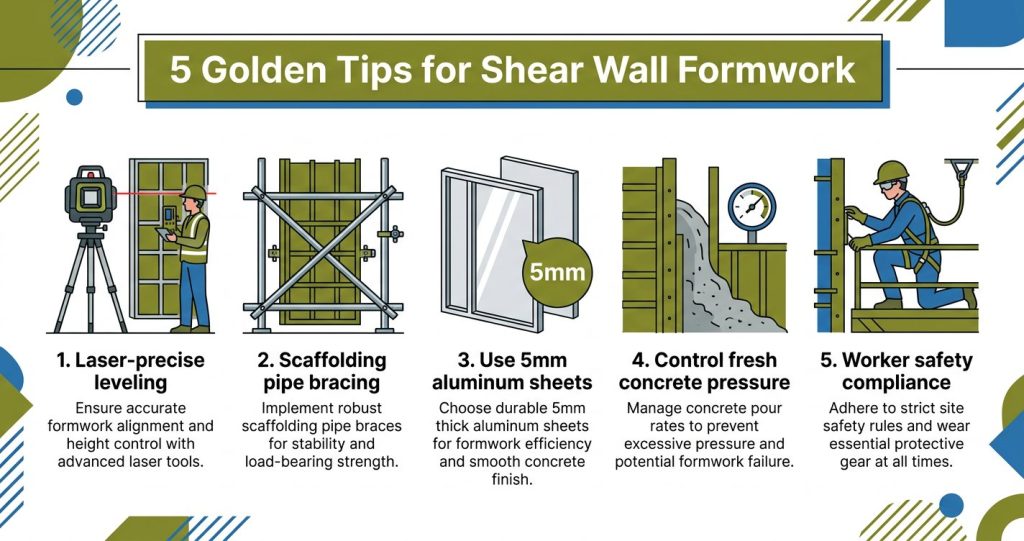
💡 Golden Tip: Before starting shear wall formwork, always verify the rebar layout and axes with a laser level or total station. Even 5 mm of deviation can shift the entire structural axis and create compliance issues.
1.1 Types of Shear Walls
Shear walls fall into three main categories: conventional reinforced concrete shear walls, shear walls with openings (for MEP installations), and composite shear walls (combining concrete and steel). In residential projects, the first type is most common, but in tall towers, composite walls are increasingly popular.
Each type requires a different approach to formwork. For instance, shear walls with openings need smaller secondary forms around the openings to prevent concrete from flowing into those spaces during pouring. These technical details are thoroughly covered in our comprehensive formwork guide.
2. Choosing the Right Panel for Shear Wall Formwork
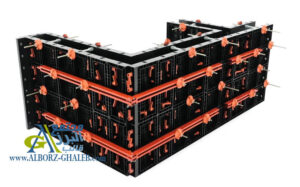
Shear wall formwork panels come in three main materials: steel, aluminum, and plastic. Each has unique advantages and limitations, which we’ve compared in the table below.
Feature
Steel Panel
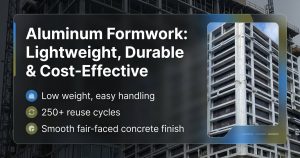
Aluminum Panel
Plastic Panel
Weight per m²
35–45 kg
18–25 kg
8–12 kg
Reuse cycles
150–200
200–300
50–100
Installation speed
Medium
High
Very high
Concrete finish quality
Excellent
Excellent
Good
Initial price per m²
$25–$35
$40–$55
$20–$28
Long-term cost
Low
Very low
Medium
Moisture resistance
High
High
Medium
Suitable for high-rise
Yes
Yes
No
ℹ️ Technical Insight: For high-rise projects above 10 stories, aluminum panels are the optimal choice. They combine lightweight construction with superior corrosion resistance and faster installation. For smaller projects, plastic panels offer the best cost-effectiveness.
2.1 Sheet Thickness and Its Impact on Quality
Panel sheet thickness is one of the most critical selection factors. A 5 mm sheet is the minimum standard for shear walls, but for high-volume pours, 6 mm or even 8 mm sheets are recommended. Thicker sheets reduce deformation under concrete pressure.
At Alborz Formwork’s facility, we produce standard 5 mm sheets for panels sized 50×100 and 120×120 cm. This thickness provides the optimal balance between weight and structural strength. For special projects like swimming pool shear walls, 8 mm sheets with heavier backing are recommended.
2.2 Panel Edge and Its Role in Sealing
Panel edges come in two standard types: 5 cm for metal panels and 8 cm for plastic panels. The edge plays a key role in sealing joints and preventing cement slurry leakage. Proper edge alignment is crucial for achieving smooth, defect-free concrete surfaces.
3. Essential Tools and Connections for Shear Wall Formwork
Proper shear wall formwork execution requires a specific set of tools and components. These elements work together as an integrated system, each playing a vital role.
Full-thread bolts: For connecting both sides of the formwork and resisting concrete pressure. Standard sizes are 16 mm and 20 mm.
Formwork straps (tie rods): An alternative to bolts when you don’t want holes in the concrete. Width 28 mm, thickness 2 mm.
Wing nuts (khoruski nuts): For tightening bolts onto panels. Available in 16 mm and 20 mm sizes.
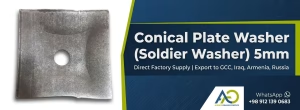
Cup washers: For distributing pressure evenly on panels and preventing surface damage.
Two-pipe washers: For reinforcing connection points and increasing pressure resistance.
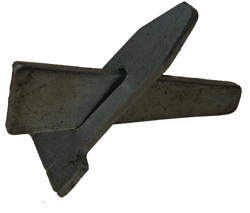
Pins and wedges: For rapid panel-to-panel connection without screws or nuts.
⚠️ Safety Warning: Using substandard bolts and straps is one of the most common causes of formwork collapse during concrete pouring. Always use certified, tested products. Low price doesn’t always mean savings—it can mean disaster.
3.1 Calculating Bolt Quantity per Square Meter
For a 30 cm thick, 3-meter-high shear wall, an average of 2 bolts per square meter is needed. However, if the height exceeds 3.5 meters, the bolt count should increase to 3 per square meter. This calculation is based on hydrostatic pressure from fresh concrete.
On a 20-story tower project in Tehran with 40 cm walls and 4-meter height, we used 4 bolts per square meter. This high density brought collapse risk to zero. Yes, bolt costs increased by 18%, but safety always wins in the end.
4. Step-by-Step Shear Wall Formwork Execution
Shear wall formwork execution follows a precise 10-step process. Following this sequence is the key to project success.
4.1 Step One: Surface Preparation and Axis Control
Before anything else, the surface beneath the wall must be completely clean and level. Any debris, soil, or even a small piece of wood can cause cement slurry leakage and create voids in the wall. Axes should be controlled with a laser level or total station.
💡 Execution Tip: For large projects, using a total station is highly recommended. Its accuracy reaches 2 mm over 100 meters and dramatically speeds up the work.
4.2 Step Two: Rebar and Connection Plate Installation
After preparation, it’s time to install the rebar. Vertical and horizontal rebars must be placed according to the drawings with proper concrete cover (minimum 2.5 cm). Connection plates should also be positioned at their designated locations.
4.3 Step Three: Installing One Side of Panels
Panel installation begins on one side. Panels must be perfectly level both vertically and horizontally. Spacing between panels is controlled with spacers to ensure exact wall thickness as per drawings.
4.4 Step Four: Installing Bolts and Straps
Bolts are pre-placed inside the formwork and tightened with wing nuts from the opposite side of the wall. Formwork straps are used instead of bolts when you want to avoid leaving holes in the concrete.
4.5 Step Five: Installing the Other Side of Panels
The other side’s panels are placed after the bolts are installed. At this stage, care must be taken to ensure the panels are perfectly aligned opposite each other.
5. HSE Safety in Shear Wall Formwork
Safety in shear wall formwork is more important than execution speed. A small accident can shut down the entire project and cause irreparable human and financial losses.
5.1 Personal Worker Safety
Every worker must use a hard hat, safety boots, gloves, and safety harness. Above 2 meters height, scaffold installation and safety nets are mandatory. At Alborz Formwork projects, HSE safety training is required before starting any project.
⚠️ Serious Warning: In 2023, 12% of construction site accidents in Iran were related to formwork collapse. This alarming statistic shows that safety compliance is not a choice—it’s an absolute necessity.
5.2 Structural Safety of Formwork
Formwork must be inspected regularly. Any damaged panel, rusted strap, or bent bolt must be replaced before use. The load-bearing capacity of the formwork must match the concrete pressure.
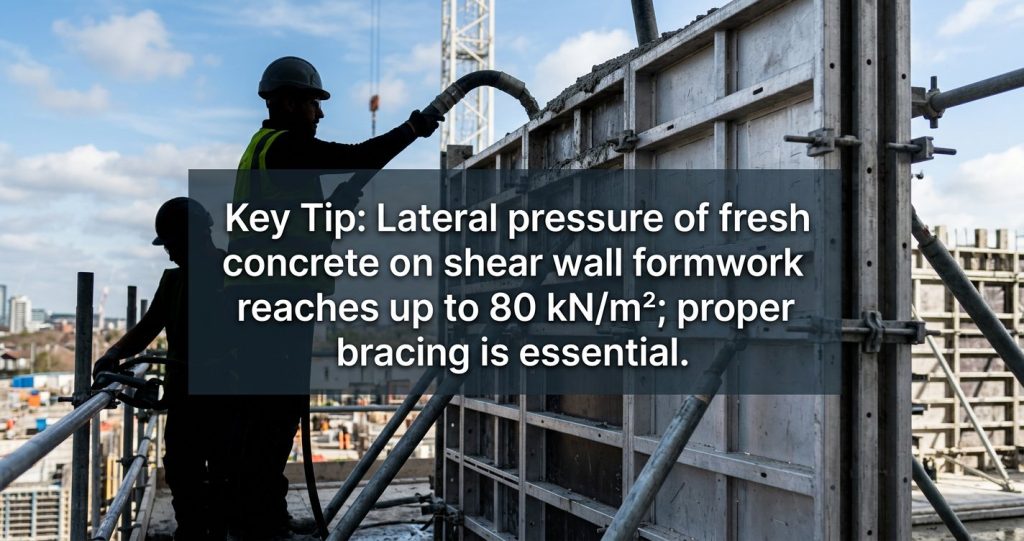
Lateral pressure calculation for fresh concrete follows ACI 347 formula. This formula predicts a maximum pressure of 98 kN/m² for concrete with 15 cm slump at 20°C. In practice, we usually work with a safety factor of 1.5.
5.3 Risk Management on Site
Before each work shift, a Toolbox safety meeting should be held. Daily risks should be identified and preventive measures specified. This safety culture must be institutionalized at all levels of the construction site.
6. Golden Tips and Common Mistakes in Shear Wall Formwork
Over years of experience, we’ve compiled a list of common mistakes and golden tips that we share below.
6.1 Five Common Mistakes
Mistake One: Insufficient spacer use between panels. This changes wall thickness and consequently alters the structure’s safety factor.
Mistake Two: Insufficient tightening of bolt nuts. This causes the formwork to open under pressure during concrete pouring.
Mistake Three: Improper formwork lubrication. Without proper oil, the formwork sticks to the concrete and removal becomes extremely difficult.
Mistake Four: Installing formwork before completing rebar installation. This causes rebars to be placed in incorrect positions.
Mistake Five: Not using proper scaffolding. At height, workers cannot work properly and fall risk increases dramatically.
6.2 Five Golden Tips for Flawless Execution
First, always conduct a 30-minute final inspection of the entire formwork before pouring. Second, start pouring from one side to distribute pressure evenly. Third, use vibrators with appropriate diameter for the rebar spacing.
Fourth, monitor concrete temperature. Above 30°C, concrete sets faster and exerts less pressure on formwork. Fifth, at the end of each shift, clean and lubricate the formwork so it’s ready for the next cycle.
7. Economic Analysis of Shear Wall Formwork
Shear wall formwork costs typically account for 15 to 25% of the total structural cost. This figure highlights the importance of optimizing this phase.
7.1 Economic Comparison of Three Panel Types
For a 1000 m² shear wall project, economic comparison reveals interesting findings. Steel panels have higher initial investment but are more economical long-term due to higher cycle counts. Aluminum panels offer the best balance between price and durability.
ℹ️ Precise Calculation: For a 1000 m² project with 50 reuse cycles, the cost per cycle for aluminum panels is around $1.5 USD, while steel panels cost $1 USD per cycle and plastic panels cost $0.7 USD. However, aluminum panels deliver superior concrete surface quality.
7.2 ROI on Used Formwork Purchase
Purchasing quality used panels can save up to 40% on costs. Our dam concrete formwork guide shows how large infrastructure projects also benefit from quality used formwork systems.
8. Final Summary and Expert Recommendations
Shear wall formwork is a combination of science, experience, and precision. None of these three can be ignored. Choosing the right panels, using standard tools, following exact execution steps, and adhering to HSE safety are the four pillars of success in this work.
If you’re facing specific challenges in your project, the Alborz Formwork technical team is ready to provide expert consultation. With over 20 years of experience in formwork production and execution, we can propose the best solution for your project.
1. What is the best sheet thickness for shear wall formwork panels?
The minimum standard sheet thickness for shear wall formwork is 5 mm. However, for large projects with high-volume concrete pours and heights above 3 meters, 6 mm or 8 mm sheets are recommended. Thicker sheets increase formwork resistance against lateral concrete pressure and reduce deformation.
2. How many bolts per square meter are needed for shear wall formwork?
For a 30 cm thick shear wall up to 3 meters high, a minimum of 2 bolts per square meter is needed. Above 3.5 meters height, this should increase to 3 or even 4 bolts per square meter. Precise calculation is based on hydrostatic pressure from fresh concrete with a 1.5 safety factor.
3. When should formwork straps be used instead of bolts?
Formwork straps are used when you don’t want holes in the concrete surface. This is important for exposed walls, pool walls, or walls requiring complete waterproofing. Straps come in widths from 40 to 70 cm with 2 mm thickness, providing sufficient strength.
4. Can shear wall formwork be executed in winter?
Yes, but with specific precautions. Below 5°C, concrete should be mixed with warm water and anti-freeze additives. Formwork must also be cleared of ice and snow before pouring. Formwork removal time should be at least 48 hours in cold weather.
5. What is the service life of aluminum panels?
The service life of aluminum panels with proper maintenance is between 200 to 300 reuse cycles. In real projects with proper care (cleaning, lubrication, and timely repairs), panels can even last up to 400 cycles.
6. How to prevent cement slurry leakage?
To prevent cement slurry leakage, joints between panels should be sealed with gasket tape. Using high-quality panels with precise edges also plays a key role in preventing leakage. Ultimately, perfect panel alignment contributes significantly to this issue.





Your opinion matters to us
Share your experience and thoughts with us and other users
No comments yet. Be the first!