Here’s the thing: for decades, contractors had two choices — heavy steel panels that needed a crane, or timber that warped after a dozen pours. Aluminum formwork changed that equation. At roughly one-third the weight of steel, with 250+ reuse cycles and a concrete finish so smooth you can skip plastering, it’s quietly become the go-to system for mass housing projects worldwide.
You know what? By the end of this guide, you’ll know exactly when aluminum formwork makes financial sense, when it doesn’t, and how to compare it against other systems. If you want a broader overview first, check out this complete guide to concrete formwork systems — it covers the whole landscape in one place.
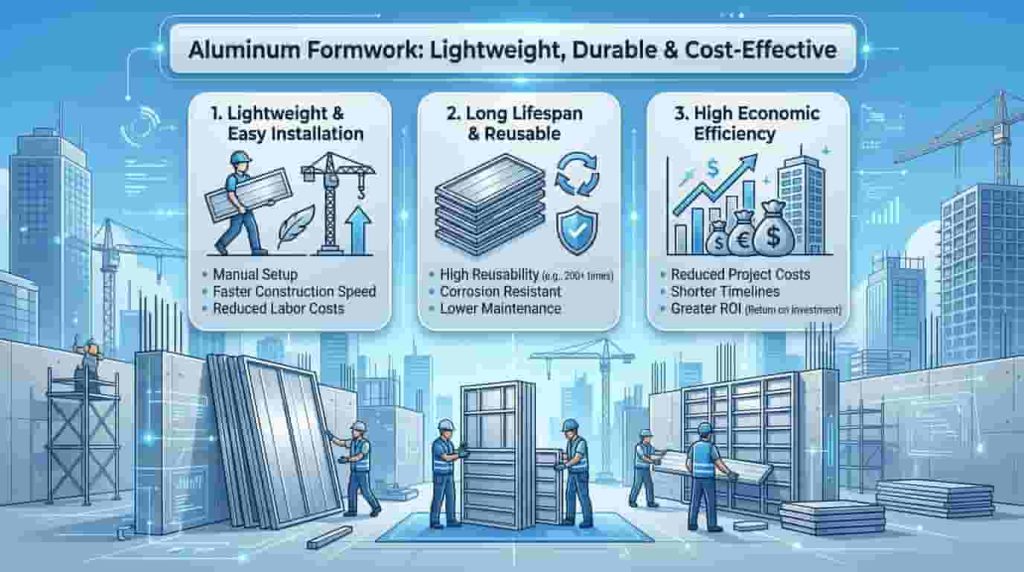
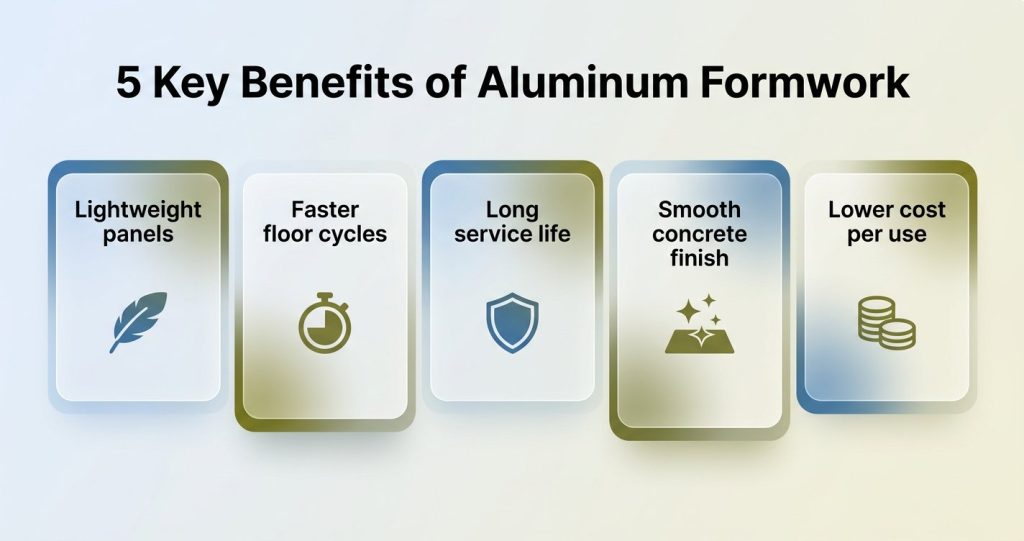
Infographic: five reasons builders are switching to aluminum formwork
What Is Aluminum Formwork?
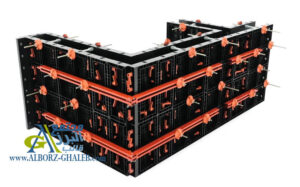
Aluminum formwork is a modular system of extruded aluminum panels — typically 6061-T6 alloy with a 4 mm face sheet — that lock together with pins and wedges. Walls, columns, slabs, beams and even staircases are cast monolithically in a single pour, which is why structural engineers love it for seismic zones.
A Quick Origin Story
The system was popularized in Malaysia and South Korea for high-volume housing, then spread across the Middle East and South Asia. Today it dominates projects where the same floor plan repeats ten, twenty, or fifty times.
Core Components
Wall and slab panels
Internal and external corners
Beam, staircase and lintel components
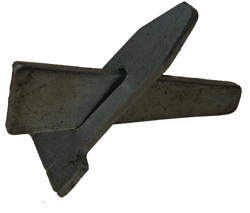
Pins, wedges, wall ties and washers
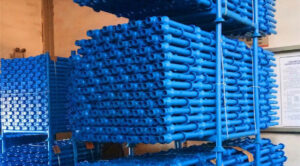
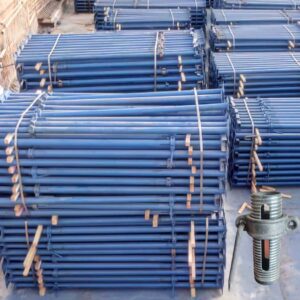
Props and supporting jacks
Key Benefits: Why the Hype Is Justified
1) Genuinely Lightweight
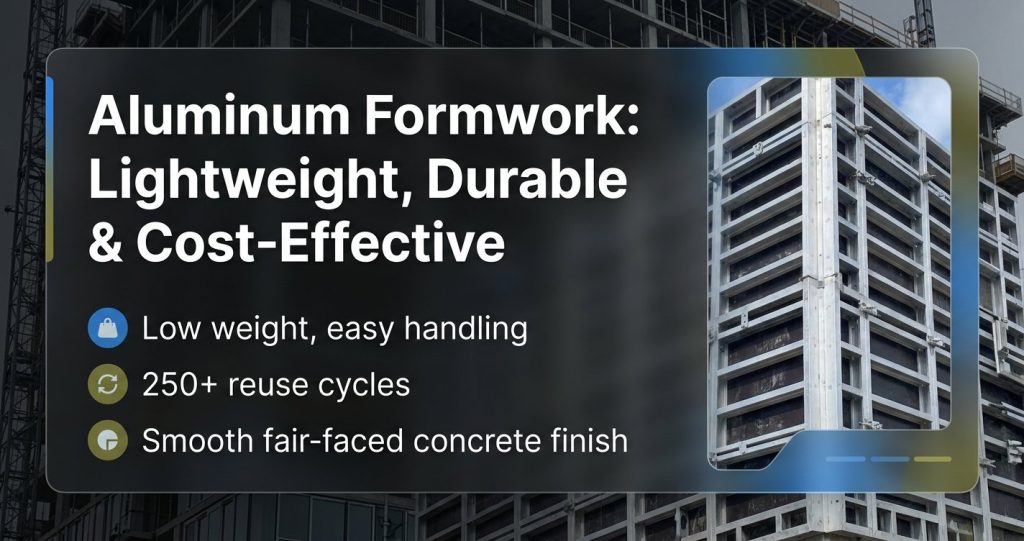
Panels weigh 19–25 kg/m². One worker can carry and fix a panel by hand — no tower crane needed for formwork logistics. On congested urban sites, that alone can save thousands per month.
2) Durability Without Rust
Aluminum doesn’t corrode the way steel does. With basic cleaning and proper form oil, 250–300 reuses are standard, and some manufacturers warrant up to 500 cycles.
3) Fair-Faced Finish = No Plastering
The cast surface comes out smooth enough to paint after a skim coat — or no coat at all. Honestly, removing the plastering trade from your schedule is where much of the hidden savings lives.
💡 Pro tip: aluminum holds excellent scrap value. Even at end-of-life, your formwork stock recovers a meaningful share of the initial investment — effectively lowering your real cost of ownership.
Aluminum vs. Steel vs. Plastic Formwork
Each system has a sweet spot. Steel modular systems remain the workhorse for varied, non-repetitive projects — see this detailed page on modular metal formwork for specs and use cases. Here’s how they stack up:
Criterion
Aluminum
Steel Modular
Plastic
Weight per m²
19–25 kg
45–60 kg
10–15 kg
Reuse cycles
250–300
150–250
50–100
Surface finish
Excellent (fair-faced)
Good
Fair to good
Initial cost
High
Medium
Low
Corrosion resistance
Excellent
Needs paint/maintenance
Excellent
Best for
Repetitive mass housing
Varied, general projects
Small/medium projects
⚠️ Warning: aluminum formwork is custom-engineered around your floor plan. If your layouts change from floor to floor — or project to project — the economics fall apart fast. Non-repetitive designs are usually better served by steel modular systems.
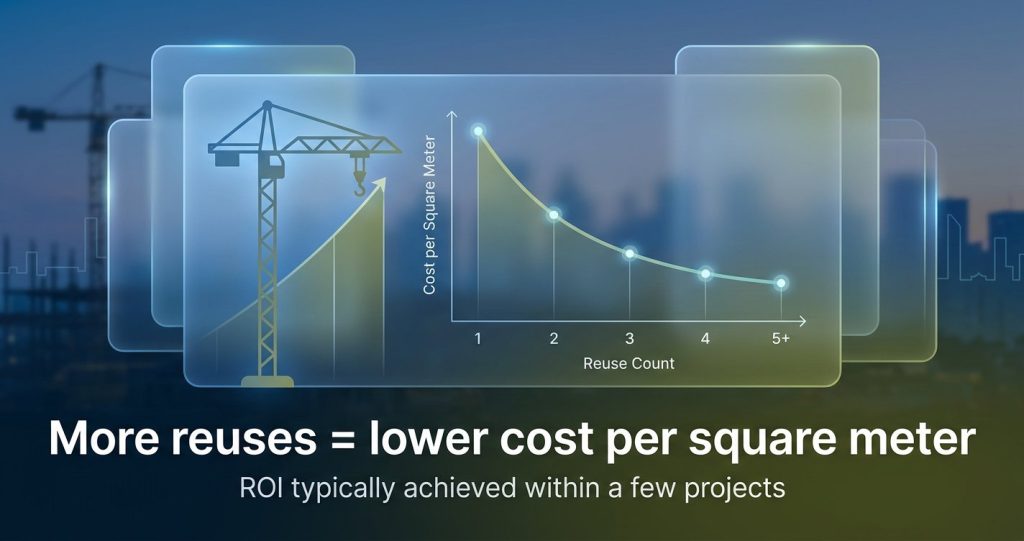
The more reuse cycles, the lower your cost per square meter
Cost Analysis & ROI: Does It Actually Pay Off?
The Simple Math
Say the upfront cost is double that of steel. Spread it over 300 uses instead of 200, then add the savings: no crane hire for forms, roughly half the formwork labor, plastering eliminated, and floor cycles cut from 10–12 days to 5–7. On projects above ~50 units, payback typically lands within two to three projects.
What Drives the Price?
Global aluminum billet prices
Plan complexity and number of special components
New vs. second-hand stock
Brand, alloy grade and accessory quality
Applications & Site Tips
Where It Shines
Mass housing with repetitive floor plans
Load-bearing wall residential towers
Fast-track projects with tight handover dates
Maintenance Checklist
Clean panels after every pour — never let slurry harden
Use aluminum-compatible release agents
Inventory pins and wedges separately after each cycle
Before signing anything, send your architectural and structural drawings to the supplier and request shop drawings plus a complete bill of materials. Lock alloy grade, sheet thickness, accessory specs and after-sales support into the contract. A supplier with real manufacturing experience will save you far more than a discount ever will.
📌 TL;DR: Aluminum formwork weighs about a third of steel, delivers 250–300 reuses, produces fair-faced concrete that eliminates plastering, and cuts floor cycles nearly in half. Upfront cost is high, but on repetitive mass-housing projects ROI usually arrives within 2–3 projects. For non-repetitive layouts, steel modular formwork remains the smarter buy.
Frequently Asked Questions
How much does aluminum formwork weigh?
Typically 19–25 kg per square meter — about one-third of an equivalent steel panel. A single worker can handle panels manually, removing the need for crane-assisted formwork moves.
How many times can aluminum formwork be reused?
With proper cleaning and release agents, 250–300 cycles are standard; some manufacturers warrant up to 500. Aluminum’s corrosion resistance is the key reason it outlasts plywood and rivals steel.
Is aluminum formwork cheaper than steel formwork?
Not upfront — it usually costs more initially. But over hundreds of reuses, with labor, crane and plastering savings factored in, the cost per use on repetitive projects is often significantly lower.
What are the main disadvantages of aluminum formwork?
High initial investment, custom engineering tied to one floor plan, and limited flexibility for design changes mid-project. It’s a system you commit to — which is exactly why it rewards repetition.
Bottom line: aluminum formwork is an investment, not an expense. If your project repeats its floor plan and your schedule is tight, it can halve your cycle time and remove entire finishing trades from the budget. Get a proper quotation and panel layout analysis before you commit.





Your opinion matters to us
Share your experience and thoughts with us and other users
No comments yet. Be the first!