


kwikstage Scaffolding

🏭 Factory Direct Production
Kwikstage Scaffolding — Modular Steel Access with Wedge-Lock Connection
Kwikstage Scaffolding (also known as Quick Stage or star-wedge scaffolding) is one of the world’s most efficient modular steel scaffold systems, featuring a unique wedge-lock mechanism that locks horizontal ledgers onto vertical star nodes with a single hammer blow. Alborz Ghaleb Industrial Complex in Karaj, Iran, manufactures and supplies Kwikstage components with full technical verification — including material grade, wall thickness, weld quality, and dimensional accuracy. Our system is exported to Iraq, Armenia, Russia, Turkey, and GCC countries with full packing, documentation, and logistics support.
What Is Kwikstage Scaffolding and Why Do Professionals Choose It?
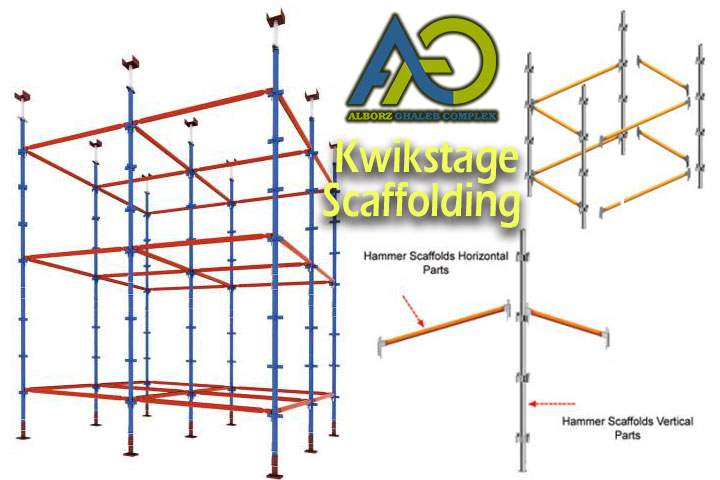
Kwikstage Scaffolding is a complete modular access system designed for facade work, industrial maintenance, temporary structural support, and multi-level access platforms. The name “Kwikstage” reflects its defining advantage: rapid stage-by-stage assembly. The system is built around vertical standards with star-shaped 4-pronged nodes welded at regular 50 cm intervals. A horizontal ledger with a C-shaped jaw head hooks over one prong of the star node, and a tapered wedge pin is driven in from above with a controlled hammer strike — locking the connection instantly. This elegant simplicity is the secret behind the system’s legendary speed.
Unlike traditional tube-and-clamp scaffolding that requires dozens of nuts, bolts, and wrenches, Kwikstage is assembled without any specialized tools — just a hammer. This translates to 50–70% faster erection and dismantling compared to conventional scaffolding. If your project requires a modular scaffolding system with proven reliability and high reuse value, Kwikstage from Alborz Ghaleb is the answer. For projects that also need slab support, our heavy-duty prop jacks integrate seamlessly with the Kwikstage layout.
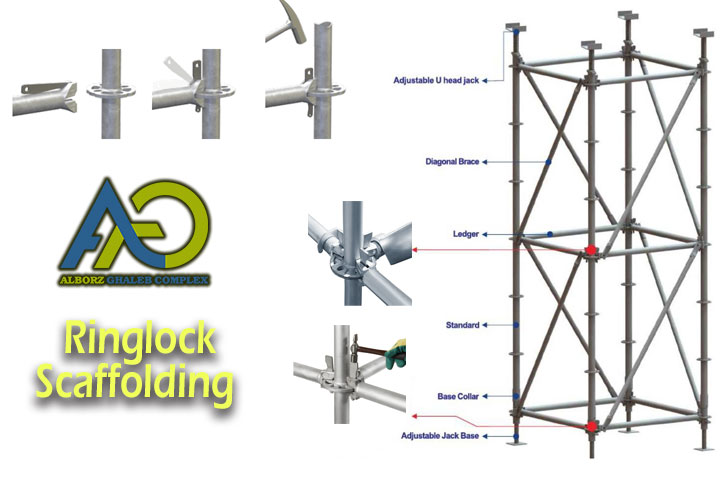
Critical technical note: The Kwikstage wedge-lock geometry is fundamentally different from Ringlock (circular rosette connection) and Cuplock (top-and-bottom cup connection). Mixing components from different systems — even if they appear to fit — is strictly prohibited without an engineer’s explicit approval. Load capacity is not a single fixed number: it depends on tube diameter, wall thickness, steel grade, node spacing, ledger length, bracing configuration, tie patterns, base conditions, and applied loads. This is why Alborz Ghaleb requests project drawings, height, usage type, and loading requirements before quoting.
Key Advantages of Kwikstage Scaffolding
- Unmatched Erection Speed: The wedge-lock connection is secured with a single hammer blow — no nuts, no bolts, no wrenches. Up to 3× faster than tube-and-clamp systems.
- Fully Modular Design: Standards and ledgers come in defined lengths, enabling precise bay and height planning. Components are interchangeable and reusable across projects.
- Quick Visual Inspection: Wedge engagement is clearly visible — if the wedge pin sits flush in the slot, the connection is locked. No torque wrenches or complex tests needed.
- High Reuse Value: Steel components maintain structural integrity through multiple project cycles when properly cleaned and inspected between uses.
- Organized Storage & Inventory: Standards, ledgers, braces, and base jacks are easy to separate, count, and palletize — simplifying warehouse management.
- Progressive Stage-by-Stage Expansion: The system can be erected bay-by-bay and lift-by-lift according to the assembly drawing, without dismantling completed sections.
- Complete Safety Add-Ons: Continuous working platforms, internal access ladders, top guardrails (110 cm), mid-rails (55 cm), and toe boards (15 cm) attach directly to the system.
- Multi-Purpose Applications: From building access and industrial maintenance to engineered heavy-duty shoring (with custom design) — one system, multiple uses.
- Lower Labor Costs: High assembly speed + smaller crews = direct savings on project execution costs.
Core System Components
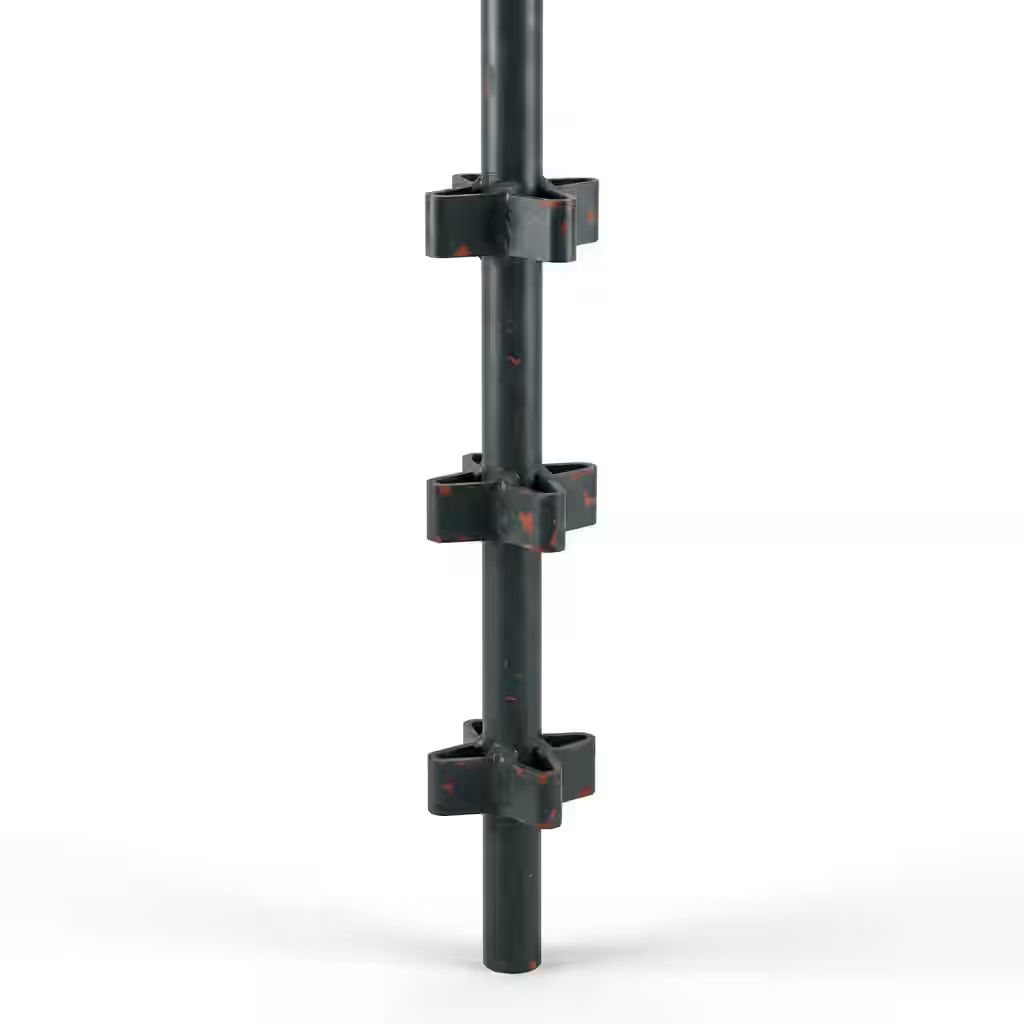
Vertical Standard
Primary vertical load-bearing member with star nodes welded at 50 cm intervals. Steel tube — diameter and wall thickness specified per order.
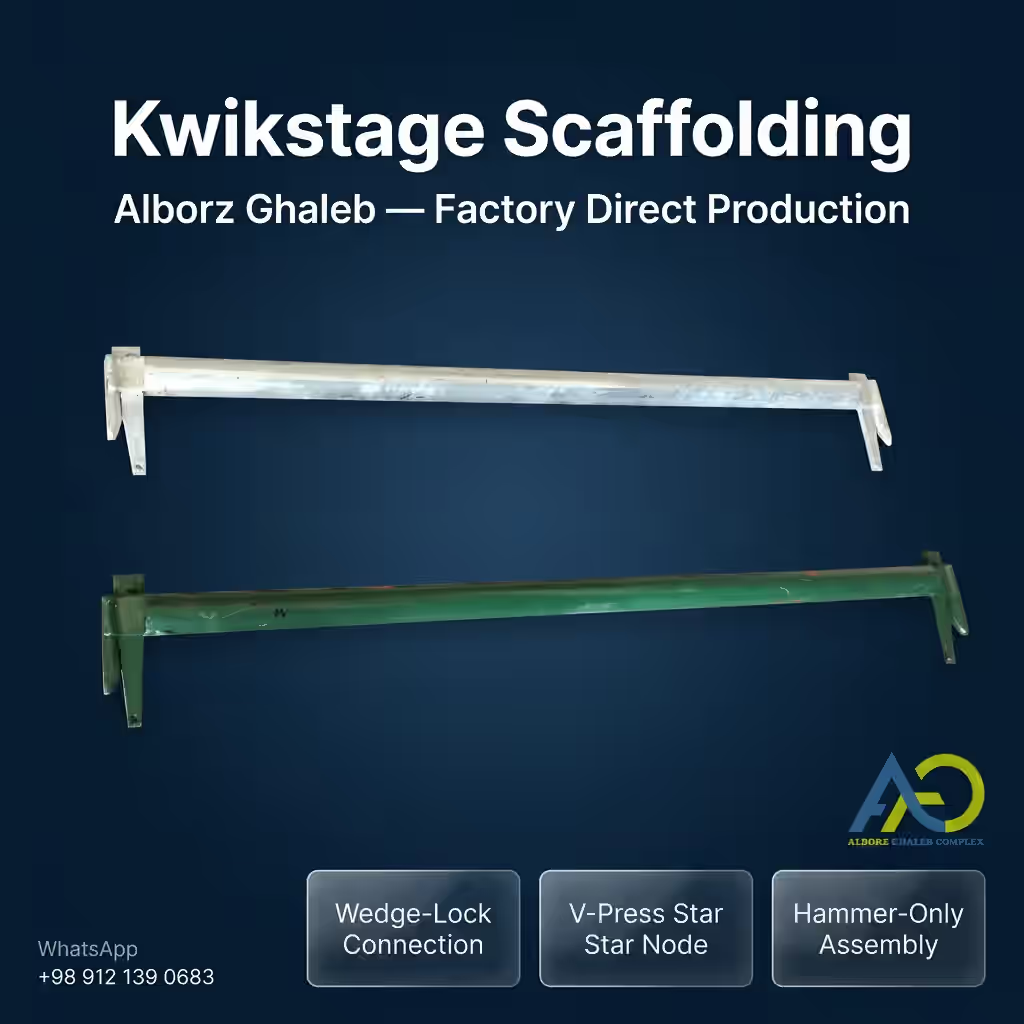
Horizontal Ledger
Connects vertical standards and forms the horizontal grid. C-shaped jaw head hooks over star node prong — secured with wedge pin.
Wedge-Lock Connection
The heart of Kwikstage: C-jaw ledger hooks over V-press star node, wedge pin driven from above with a hammer. No bolts, no wrenches.
Component Types and Classifications
1. Vertical Standards
The primary vertical members that transfer loads to the foundation. Star-shaped 4-pronged nodes are precision-welded at 50 cm intervals. Tube ends may feature spigot connections for stacking lifts or different base details for starter placement. Tube straightness, node weld quality, hole alignment, and end condition must be checked before every assembly.
2. Horizontal Ledgers
Stabilize the bay width and create the horizontal grid. Each ledger has a C-shaped jaw head at both ends that hooks over a star node prong. A wedge pin is inserted from above through a slot. Center-to-center length, tube thickness, and unit weight must be confirmed in the proforma invoice and production list.
3. Diagonal Braces
Non-negotiable for lateral stability. Thinking horizontals alone are sufficient is a dangerous — and unfortunately common — error. Brace quantity, location, and pattern must follow the engineering drawing exactly. Typically zigzag pattern across bays.
4. Base Jacks, Adjustable Jacks & U-Heads
Base jacks transfer standard reactions to the ground. Use timber sole plates (min. 3.5 cm thick) on soft ground. Adjustable jacks are for limited leveling only — never exceed the manufacturer’s maximum extension. U-head jacks support formwork beams in shoring applications. See our formwork accessories section for compatible base jacks and U-heads.
Kwikstage Scaffolding Pricing — How It’s Calculated
Kwikstage pricing cannot be compared using a single “price per piece” figure. Two quotes may appear similar in length but differ drastically in tube wall thickness, actual weight, steel grade, jaw head detail, weld quality, surface coating, and included accessories. Fair comparison requires identical bill of materials in both proposals.
Key factors affecting price:
- Quantity and lengths of vertical standards and horizontal ledgers — larger orders benefit from factory-direct volume discounts.
- Tube diameter, wall thickness, steel grade, and confirmed unit weight — heavier steel costs more but lasts significantly longer.
- Number of braces, base jacks, U-heads, and connection accessories — these supplementary items can account for up to 30% of total cost.
- Surface coating type — hot-dip galvanized, powder-coated, or bare/red oxide primer (different price points for each).
- Packing, palletizing, and loading — critical for export orders; affects container utilization and shipping costs.
- Order quantity, delivery timeline, and destination — larger tonnage and flexible scheduling yield factory discounts.
Component Control Table — Specifications Before Ordering
| Component | Function | Items to Confirm Before Order | Visual Check | Status |
|---|---|---|---|---|
| Vertical Standard | Load transfer & height formation | Length, diameter, wall thickness, node spacing (50 cm), weight | Tube straightness, node welds, end condition | Per production list |
| Horizontal Ledger | Bay formation & standard connection | Center-to-center length, tube spec, jaw head detail | Wedge pin integrity, jaw flatness | Per layout drawing |
| Diagonal Brace | Lateral stability | Length, installation points, quantity per lift | Twist, connection integrity | Per bracing drawing |
| Base Jack | Load transfer to ground | Plate dimensions, thickness, connection detail | Plate flatness, weld quality | Per ground condition |
| Adjustable U-Head Jack | Limited leveling & shoring support | Thread type, max extension, nut type | Thread health, plate flatness | Per design spec |
| Working Platform | Personnel standing surface | Bay width, load rating, end locks | Slippage, corrosion, deformation | All working lifts |
| Guardrail & Toe Board | Open edge protection | Height (110/55/15 cm), attachment method | Continuity, full locking | Mandatory at open edges |
Pre-Purchase Technical Checklist
- ✅ Drawings or dimensions of the work area, total height, and number of working lifts have been sent to Alborz Ghaleb engineers.
- ✅ Usage type — “access only” or “load-bearing shoring” — is clearly defined in writing.
- ✅ Personnel loads, material loads, equipment loads, and wind effects have been determined by the project designer.
- ✅ Length, diameter, wall thickness, and unit weight of each component are stated and confirmed in the sales proposal.
- ✅ Star node geometry, ledger jaw head, and wedge pin are compatible with any existing Kwikstage inventory on site.
- ✅ Braces, base jacks, adjustable jacks, and tie-to-structure connections are calculated in sufficient quantity.
- ✅ Working platforms, internal access, top guardrails, mid-rails, and toe boards are included — not forgotten.
- ✅ Surface coating type (hot-dip galvanized / powder-coated / bare) and project environmental conditions are specified.
- ✅ Weld acceptance criteria, twist tolerance, corrosion limits, and used-component policy are documented.
- ✅ Packing method, pallet size, loading, unloading, and component counting procedure are agreed upon.
Selection Guide — Choosing Kwikstage for Your Project Type
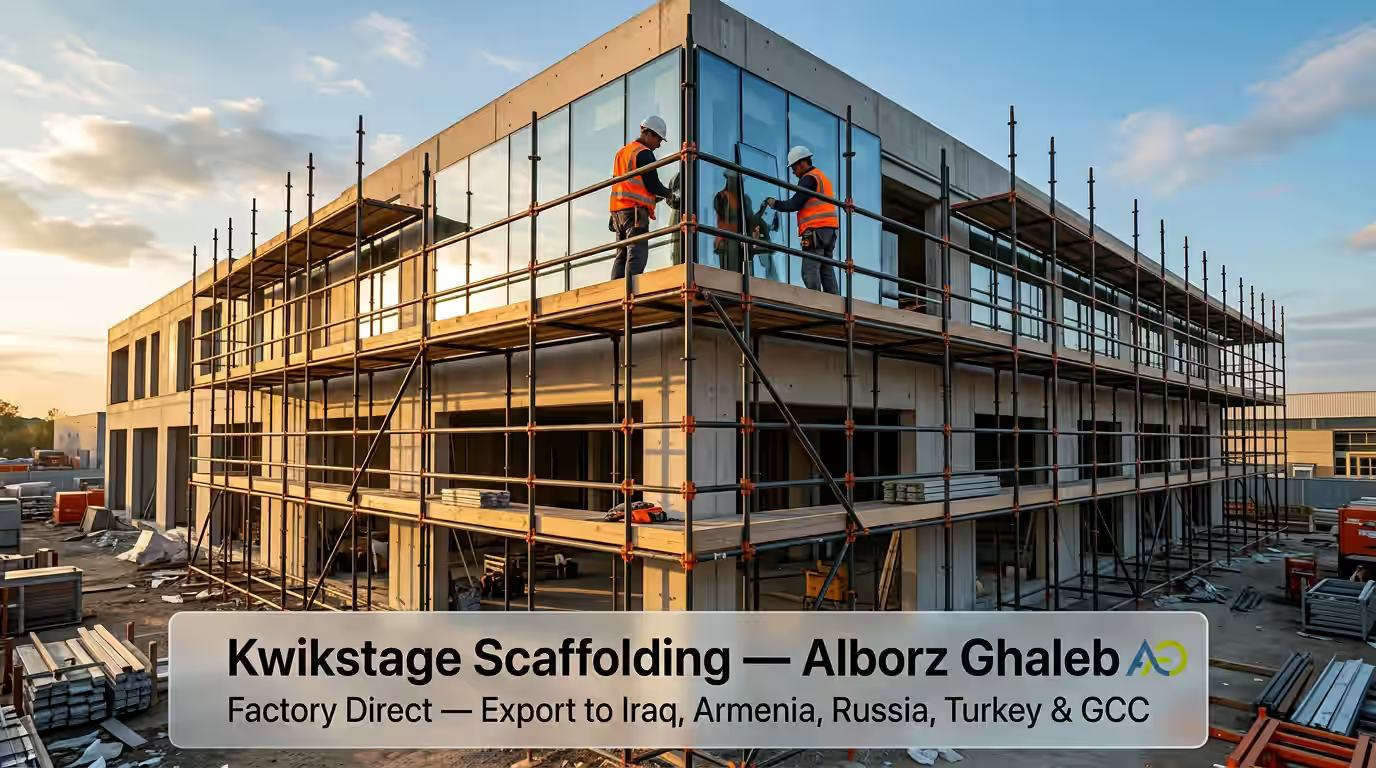
🏗️ Building Facade (Bricklaying, Cladding, Painting)
Focus on continuous access, proper standoff distance from facade (30–45 cm), internal ladder access, adequate ties to structure, and full edge protection. Platform width and material loading (brick pallets, mortar tubs) must be defined before ordering. Typical bay widths: 1.8–2.5 m with 3-board platforms.
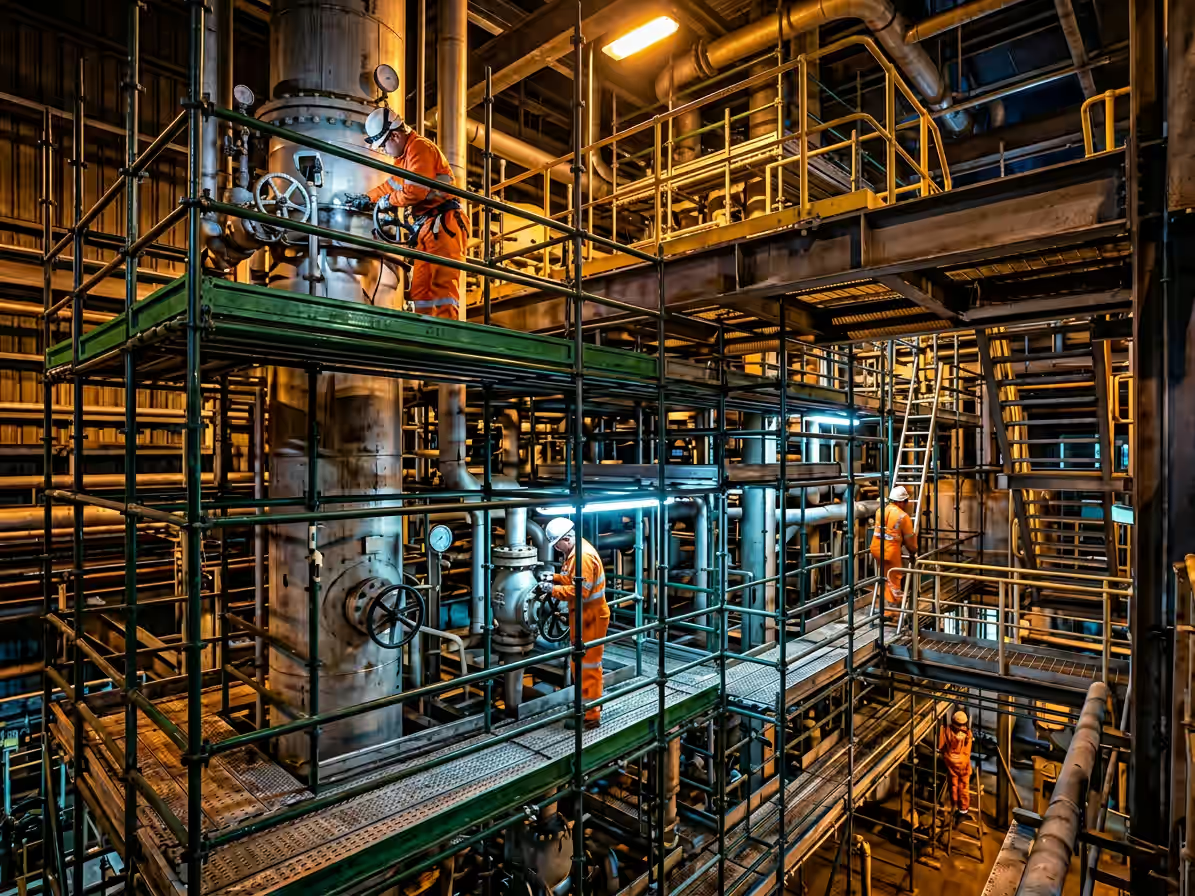
🔧 Industrial Maintenance (Refinery, Petrochemical, Cement)
Existing pipes, equipment, and obstructions make regular layouts challenging. Actual site dimensions, permissible tie points to existing structures, corrosive environment risks, and shutdown window constraints must be factored into the design. Hot-dip galvanized coating strongly recommended for corrosive environments.
🏢 Engineered Shoring (Slab Formwork Support)
Using Kwikstage as a load-bearing system requires engineered design covering: fresh concrete weight, formwork self-weight, construction live load, eccentricity, and stripping sequence. Access layouts must NOT be used directly for shoring — standard spacing is reduced and bracing is doubled in both directions.
🚢 Export Projects
Beyond technical specs: package weight, pallet dimensions, labeling, packing list, shipping documents, and coating requirements must be defined upfront. Alborz Ghaleb has proven export experience to Iraq, Armenia, Russia, Turkey, and GCC countries — managing all logistics from factory to destination port.
How to Erect Kwikstage Scaffolding — Step-by-Step Guide
Correct erection matters more than the components themselves. Perfectly manufactured scaffolding on poor ground, without bracing, or with incomplete connections can become unstable and dangerous. The competent person must provide the assembly drawing and instructions to the erection crew, and the work area must be cordoned off from unauthorized personnel. This guide is written for the site supervisor — practical, actionable, and clear.
- Review Drawings and Survey the Site: Confirm dimensions, height, obstructions, overhead power lines, openings, access routes, and structure tie points. Soft or sloped ground must be prepared per the design. Mark out bay positions with tape measure and chalk.
- Prepare the Ground: Level and compact the bearing surface. Place sound timber sole plates (min. 3.5 cm thick) and steel base jacks at grid intersections. Never use bricks, broken blocks, or loose wedges as substitutes.
- Erect the First Bay: Position the first vertical standards on base jacks. Hook the lowest horizontal ledgers onto the correct star node prongs — the C-jaw must seat fully without twisting. Insert wedge pin from above and drive it home with a controlled hammer strike. Never strike the tube or node weld.
- Check Square and Level: Before expanding, verify center-to-center distances, bay diagonals, horizontal level (laser or water level), and standard plumb. An error in the first bay multiplies at upper lifts — do not rush this step.
- Expand Bay by Bay: Add standards and ledgers one bay at a time. No wedge pin should be left half-engaged, crooked, or driven onto dirty surfaces (mud, concrete, paint). Drive all wedges fully with consistent hammer force.
- Install Braces and Ties Concurrently: Diagonal braces and ties to the structure must be installed as height increases — not after the entire scaffold is up. Brace spacing and pattern per drawing. For precise leveling use our adjustable U-head jacks.
- Complete the Working Lift: Install continuous working platforms, internal access (ladder or stair), top guardrail (110 cm), mid-rail (55 cm), and toe board (15 cm). Gaps or loose boards in the platform floor must be eliminated before use.
- Final Inspection and Tagging: A competent person inspects the foundation, standards, wedge pins (every single one), braces, ties, platforms, and edge protection. Only after written approval is the “Safe for Use” tag attached.
🛠️ Required Tools & Equipment
- Steel tape measure (min. 10 m)
- Laser level or water level + builder’s plumb bob
- System-appropriate soft-faced hammer (strike wedge pin only, never the tube)
- Chalk line or marking spray
- Hard hat, safety boots, gloves, full-body harness with lanyard
- Barrier tape and cones for work area exclusion zone
⚠️ Safety During Erection
- Never strike the tube body or node weld to tighten a wedge — hit only the wedge pin. Tube impact causes deformation and capacity loss.
- Raising multiple lifts without progressively installing braces and ties is prohibited — unbraced scaffold behaves like standing dominoes.
- Never use adjustable jacks to compensate for significant slope or height differences — the maximum safe extension is marked on the jack body.
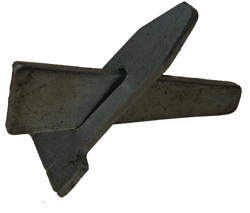
- Do not mix components from different systems (Ringlock, Cuplock, Kwikstage) — visual similarity does not equal compatibility. Use our standard wedges and pins for all connections.
❌ Common Site Mistakes
- Hitting the tube instead of the wedge: The most frequent error — a stubborn wedge is “persuaded” by hammering the tube. Result: dented standard, damaged node weld.
- Driving wedges onto dried mud or concrete: The wedge appears seated but has zero real grip. Clean node seating surfaces before assembly.
- Stacking material on a personnel-only platform: A platform rated for 2 workers and tools becomes a brick-and-mortar storage depot — an accident waiting to happen.
Applications of Kwikstage Scaffolding

Facade Access & Cladding
For bricklaying, panel installation, painting, insulation, and renovation — with designed ties, full platforms, and edge protection.
Industrial Maintenance
Temporary access around equipment, pipe racks, and structures — corrosion-resistant options available, site safety permits coordinated.
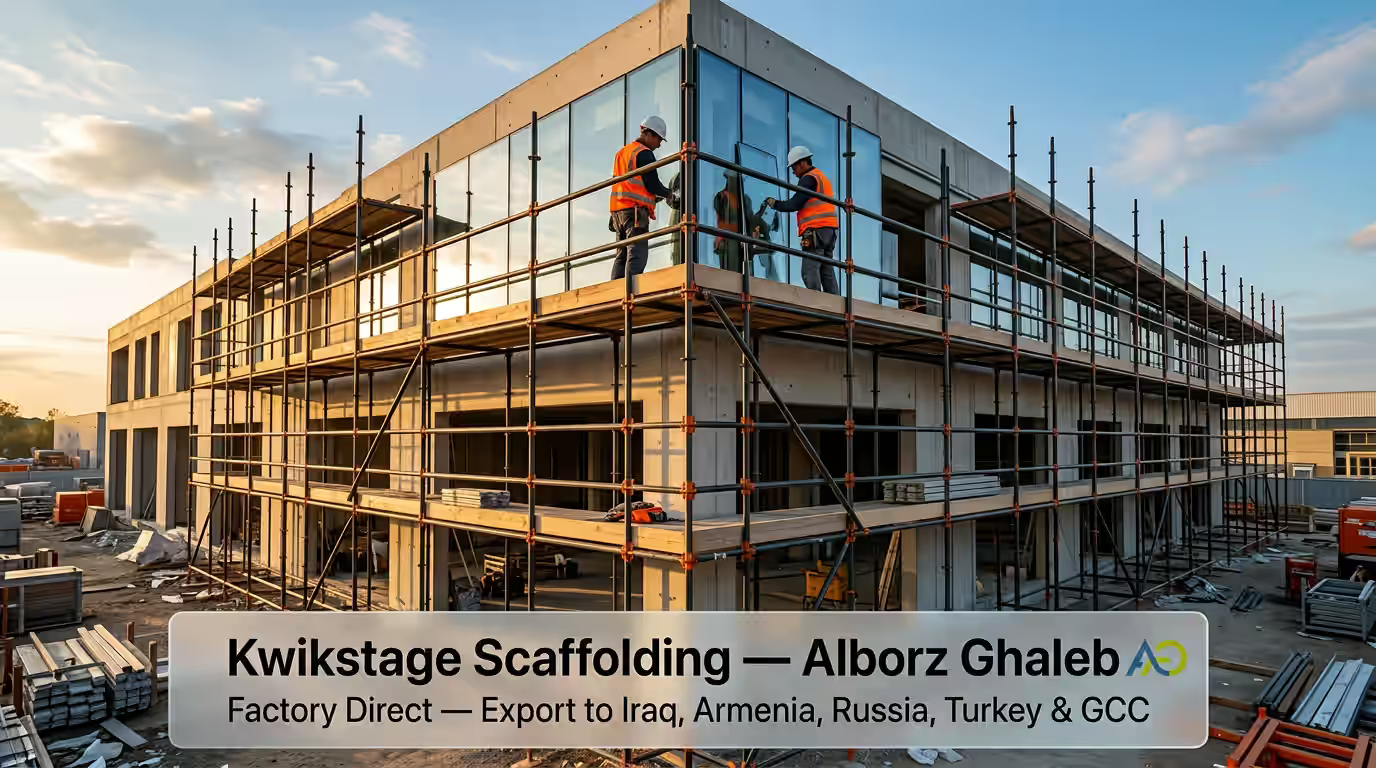
Engineered Temporary Support
For slab formwork shoring — engineered design required. Dense grid, heavy bracing, U-head jacks, and controlled stripping sequence.
Maintenance, Inspection & Long-Term Safety
- Pre-assembly visual inspection every time: Set aside bent standards, cracked welds, missing wedge pins, twisted jaw heads, and corroded components. Quarantine all rejects.
- Clean connection surfaces: Remove dried concrete, mud, paint, and flaking rust from node seats and wedge paths — a wedge on a dirty surface has no real lock.
- Proper storage: Sort components by type and length. Store on level timber dunnage, away from standing water and humidity. Palletize for forklift handling.
- No throwing components: Dropping or throwing parts from height deforms jaw heads and wedge pins. Use controlled lowering methods (rope and bucket).
- Post-event re-inspection mandatory: After strong wind, vehicle impact, ground settlement, configuration change, or extended idle period — full re-inspection required.
- Never remove members without authorization: No standard, ledger, brace, or tie is to be removed — even temporarily — to pass equipment without the competent person’s approval.
- Repairs by qualified personnel only: Weld repair or straightening must follow an approved method by qualified persons. Any questionable component must be quarantined and removed from service.
Complementary Equipment & System Selection
A complete project rarely needs scaffolding alone. Most contractors order Kwikstage alongside modular steel concrete formwork for walls and foundations, and heavy-duty steel prop jacks for slab support. Connection accessories like standard steel wedges, pins, and clamps should be ordered together to ensure full compatibility. If you’re comparing systems, the differences between Kwikstage wedge-lock, Cuplock, and Ringlock scaffolding must be evaluated based on your existing inventory, crew familiarity, loading requirements, and component availability — visual similarity alone is never a valid reason to substitute one system for another. For rebar work on the same project, our rebar cutters and rebar benders are also available. For wall bracing, don’t overlook adjustable push-pull props.
Why Alborz Ghaleb? — 20+ Years of Formwork & Scaffolding Expertise
Alborz Ghaleb Industrial Complex brings over 20 years of specialized experience in manufacturing steel concrete formwork, plastic modular formwork, modular scaffolding systems, prop jacks, rebar machinery, and formwork accessories. We are a leading direct-from-factory supplier for construction and industrial projects across Iran, Iraq, Armenia, Russia, Turkey, and the Persian Gulf states. Our factory is located at No. 80, 4th Sharghi, Behesht-e Sakineh Blvd, Kamalshahr, Karaj, Iran — and we welcome client visits with advance notice.
Our services include: bill-of-materials review, factory-direct production and supply, weight and quality control, official invoicing, free technical consultation, nationwide delivery across Iran, and full support for export orders including packing, palletization, documentation, and shipping coordination. To receive a detailed technical and commercial proposal, send your drawings, required height, usage type, number of working lifts, destination, and preferred timeline via WhatsApp to our engineering team.
Frequently Asked Questions About Kwikstage Scaffolding
What is the difference between Kwikstage and Ringlock scaffolding?
What is the correct way to lock a Kwikstage ledger connection?
What is the load capacity of Kwikstage scaffolding?
What information do I need to provide for a quotation?
Can used/second-hand Kwikstage components be safely reused?
Can Kwikstage be used for concrete slab shoring?
How often should Kwikstage scaffolding be inspected?
Hot-dip galvanized or powder-coated — which is better?
How fast can Kwikstage scaffolding be erected?
📋 Request a Kwikstage Scaffolding Quote
Send your drawings, height, usage type, number of lifts, destination, and timeline — our engineering team will prepare a detailed component list and technical proposal.
📍 No. 80, 4th Sharghi, Behesht-e Sakineh Blvd, Kamalshahr, Karaj, Iran | 📧 info@alborz-ghaleb.com
Contact for price

Formwork Pins and Wedges | Factory Direct Supply

Formwork Tie Strap / Wall Tie Band – Alborz Ghaleb Factory Direct

Concrete Slab Roof Construction & Shoring Solutions
Metal Foundation Formwork | Steel Formwork for Concrete Footings
Lite Form Reusable Concrete Molds – Replace Polystyrene Blocks
Your opinion matters to us
Share your experience and thoughts with us and other users
No comments yet. Be the first!