پرش به محتوای اصلی

Modular System Scaffolding: Types, Prices and Shoring Guide

Direct manufacturer — Alborz Ghaleb Industrial Complex, Karaj, Iran

Modular Scaffolding: Goodbye to Shaky, Unsafe Tube Scaffolds

Have you ever felt traditional tube-and-coupler scaffolding tremble under workers' feet? On today's modern, heavy projects, traditional methods no longer cut it. When a 6-metre-high slab must be poured or a massive bridge built, safety and load capacity come first. That's where modular (system) scaffolding enters the field.

These industrial prefabricated systems not only speed up erection by up to 4×, they reduce human error (wrongly tightened couplers) to zero. As a specialist manufacturer of modular systems, Alborz Ghaleb walks you through the world of these temporary structures and helps you choose the right system — triangular frame or star — for your project.

Modular scaffolding is not just an access tool; it is an engineered system for shoring under heavy slabs. By eliminating bolt-tightening errors and replacing them with precise male-female connections, it guarantees structural stability during the pour.
Triangular and star modular scaffolding manufactured by Alborz Ghaleb

Types of Scaffolding Systems — Explore Each System

Click any card for full specifications, weight chart and price of that system:
What Are Scaffolding Systems?

Scaffolding systems are temporary structures erected to support workers and materials during construction, maintenance, or repair of buildings and other structures. These systems provide a safe and stable platform for workers to perform tasks at various heights. They are essential in ensuring worker safety and facilitating efficient workflow in construction and related industries.

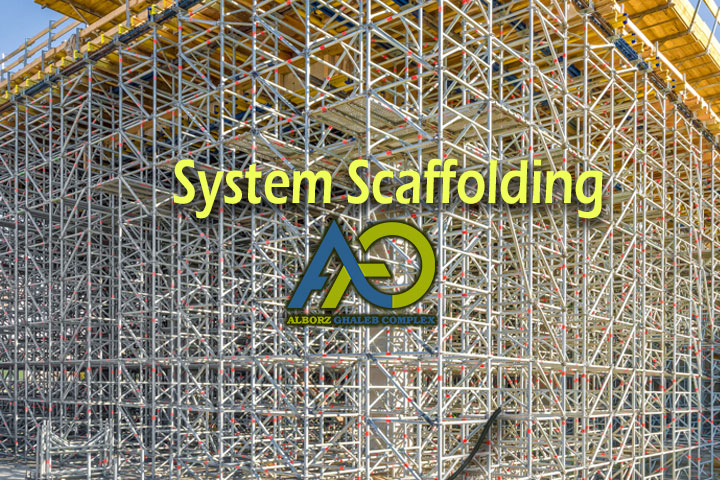
System scaffolding, also known as modular scaffolding, consists of vertical and horizontal structural components. It is known as the system of standards for implementation, with pre-engineered joints and supports or transoms. It often provides an advantage over other types of scaffolding because it's safer, has a greater load capacity, can accommodate complex design structures and taller vertical heights, and is easier to assemble and store.
System scaffolding overview at Alborz Ghaleb production line

What Is Modular Scaffolding and Why Is It Called a Construction Revolution?

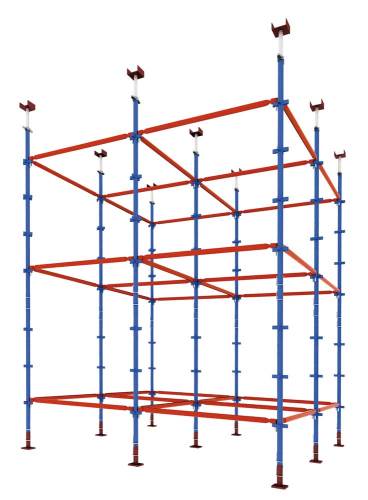
In the simplest definition, modular scaffolding is a set of prefabricated parts — vertical standards, horizontal ledgers and diagonal braces — that connect without a single wrench, using only a hammer blow or pin placement. "Modular" means unit-based: by combining standard parts you can reach any height and width you need.

The fundamental difference from old methods lies in load transfer. In modular systems, the slab load travels axially and directly through the standards to the ground, whereas the stability of traditional scaffolds depends heavily on how tightly each coupler was fastened. That's why on most projects using modern modular concrete formwork, engineers' first choice for shoring is a modular system.

Key features

  • No skilled labour needed: assembly feels like Lego — even unskilled workers manage it;
  • Free-standing: these systems need no wall to lean on; they keep their own balance;
  • Exceptional load capacity: engineered for shoring heavy concrete slabs.
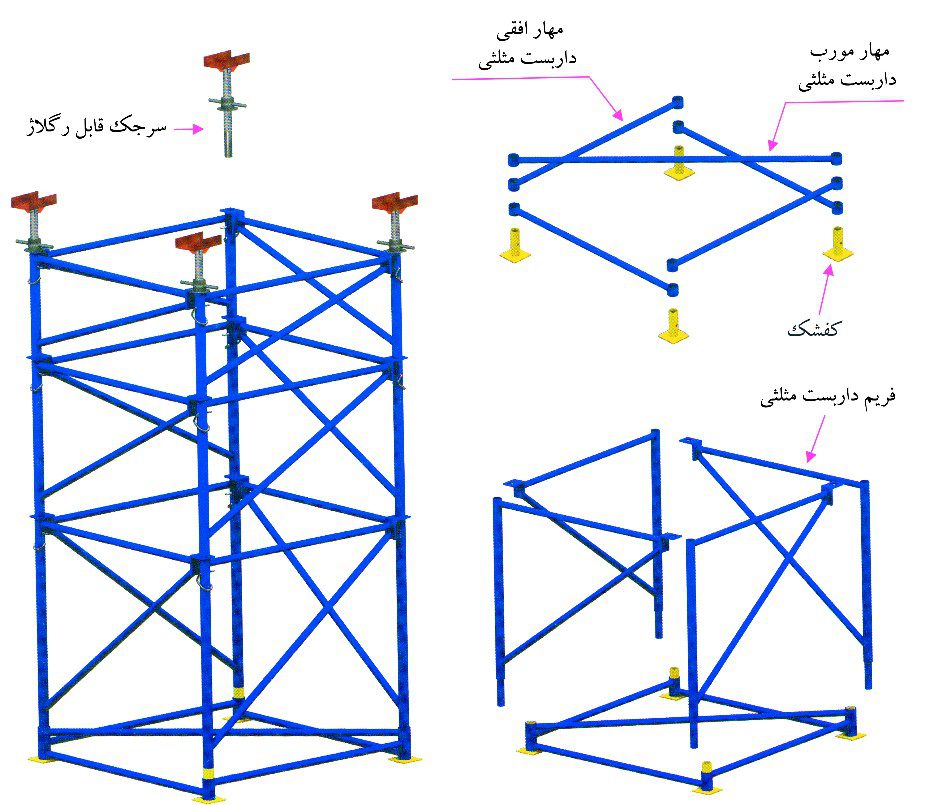
Omega triangular modular scaffolding frames for bridge shoring

Components of Scaffolding Systems

Scaffolding systems consist of several key components that work together to provide support and stability:

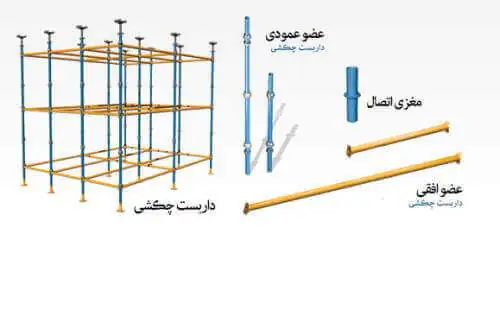
  • Standards (vertical tubes): the main load-bearing members that transfer weight to the ground;
  • Ledgers (horizontal tubes): connect the standards and provide lateral support;
  • Transoms: horizontal tubes that support the scaffold boards or platforms;
  • Couplers: fittings used to securely connect the various components;
  • Diagonal braces: stability against lateral loads (wind or concrete impact);
  • Adjustable U-head jack: sits atop the standard for precise levelling under the formwork;
  • Base jack (base plate): spreads the leg load on the ground and prevents settlement;
  • Platforms and stairs: safe worker access on facade scaffolds.

All parts must be produced to tight standards so that, combined with modular formwork, they form a flawless shoring system.

The Main Modular Systems — Anatomy and Choice

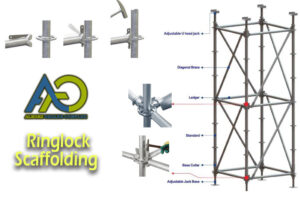
Every project needs a specific scaffold type depending on slab thickness and floor height. Several main systems rule the market, and choosing right is the key to your project's success. Alborz Ghaleb manufactures these flagship systems and offers industry-leading models such as Layher-style triangular, Cuplock, Kwikstage and Ringlock.

Triangular Frame Scaffolding (Omega) — the Heavy-Load Champion

Also known as frame scaffolding, it consists of triangular frames that stack male-into-female. Thanks to its triangular geometry it offers exceptional rigidity — the ideal choice for shoring heavy concrete slabs and bridges where the dead load of concrete is enormous.

  • Main advantage: the highest load capacity of all scaffolds (up to 14 t per leg) — the best option for bridge building and very heavy slabs;
  • Erection: no tools at all (not even a hammer!) — frames simply slot onto each other; semi-skilled crews erect huge volumes in record time.

Star (Wedge-Lock) Scaffolding — Flexibility at Height

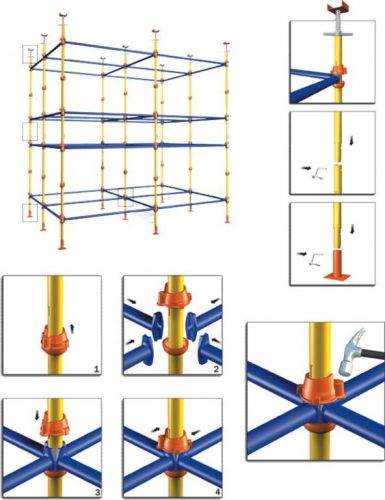
Stars are welded onto the vertical standards, and horizontal ledgers lock into these star pockets with a hammer blow. If your project has unusual spans or variable heights, the star system is the best pick.

  • Main advantage: high flexibility — handles circular, curved and irregular plans too;
  • Dual use: serves not only slab shoring but also facade access scaffolding;
  • Storage: fast dismantling and compact warehousing are key advantages.

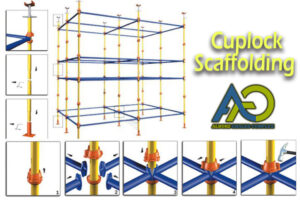
Cuplock Scaffolding — Fast and Versatile

Cuplock is a tube-and-fitting scaffold system designed for efficiency and safety. Cuplock systems utilize steel tubes connected by angled cup connectors that grip the tubes firmly. The cup connectors allow for flexible adjustments of tube positions and heights while maintaining a rigid scaffold structure.

  • Tight-fitting cup connectors that securely hold steel tubes of varying diameters;
  • Fast assembly — up to 70% faster than traditional frame scaffolding;
  • Heavy-duty galvanized steel tubes and components for durability and corrosion resistance;
  • Compliance with ISO, OSHA and Iranian safety standards;
  • Load capacities ranging from 530 to over 860 lbs/ft² (light, medium and heavy duty).

Kwikstage Scaffolding

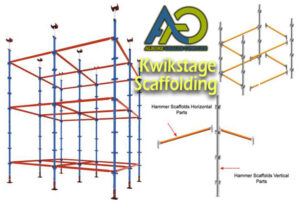
Kwikstage is a proprietary adjustable-height scaffolding system using a modular design of prefabricated steel components that easily slot together. The main parts are vertical tubes, horizontal rails and fittings. It is widely used for facade work and housing projects thanks to its speed and adaptability.

Stair-Tower Modular Scaffolding

Similar to the star model but designed with steps and landings for easy worker access. Use: projects with frequent worker traffic. Advantage: extra safety and comfort set it apart.

Standard production heights

  • Triangular frames: standard heights of 0.5, 0.75 and 1 m with male-female joints;
  • Star standards: verticals from 0.5 to 3 m with hammer-lock ledgers.
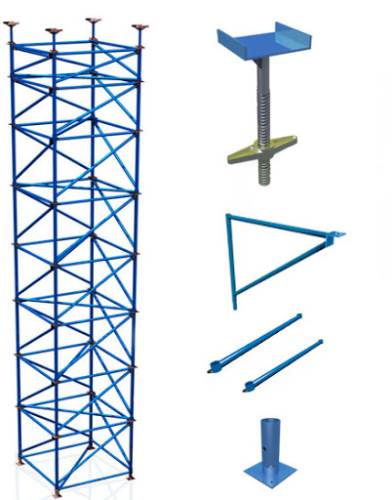
Star modular scaffolding during slab shoring erection Cuplock and star scaffolding by Alborz Ghaleb Scaffolding standards and ledgers ready for delivery

Technical Comparison — Which System Should You Buy?

FeatureTriangular (Omega)Star (wedge-lock)
Main useshoring heavy slabs and bridgesfacade scaffolds and complex shoring
Load capacityvery high (up to 14 t per leg)high
Plan flexibilitylow (linear and square only)excellent (rotation and angles)
Labourunskilled workersemi-skilled worker
Loose partsnonepin & wedge (some models)
Erection toolnone (male-female slotting)hammer only
Transport costlower (frames pack tighter)medium

Why Use Modular Scaffolding? (Advantages over Traditional)

Choosing modular is not just a technical decision — it's a smart economic one:

  • 1) Erection & dismantling speed: up to 300 m³ of modular scaffold can be erected per day;
  • 2) No tiny fittings: no thousands of bolts, nuts and couplers to lose;
  • 3) 100% safety: parts interlock — slipping is impossible;
  • 4) Up to 4× faster execution than traditional tube scaffolding;
  • 5) Human error eliminated: precise male-female joints replace couplers whose tightness depends on worker skill.
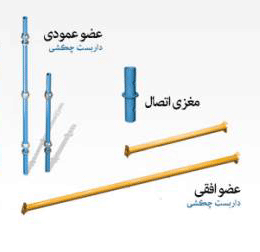
Star scaffolding standards and ledgers in the Alborz Ghaleb warehouse

Modular Scaffolding vs Prop Jacks — Which Is More Economical?

  • Use prop jacks for heights below 4 m and ordinary slabs — the most economical route;
  • Use modular scaffolding once the ceiling exceeds 4.5 m or the slab is heavy: prop jacks lose buckling stability there.

Use Under Flat and Waffle Slabs

  • Tall floors: above 3.5–4 m, props become dangerous — modular scaffolding is the only safe option;
  • Waffle slabs: long-span systems like waffle slab moulds need reliable shoring from triangular or star scaffolds.

The Role of Scaffolding in Construction Projects

Scaffolding systems play an indispensable role in the execution of construction projects by providing temporary structures to support access and working platforms. They allow workers to reach different heights safely and efficiently in order to perform tasks like fixing insulation, applying render and paintwork, installing cladding, and performing maintenance activities. This original system has been undergoing continuous development and offers an impressive variety of use: on any construction site, in industry, chemical plants, power stations, shipyards and for events — as scaffolding for working, protection, facade work or support, as internal or birdcage scaffolding, or as rolling towers.

Safe Erection and Dismantling Guide

  • Ground preparation: soil under the legs must be fully compacted and level; sole boards are essential on soft ground;
  • Plumb standards: even a 1° lean can cut the system's load capacity by up to 30%;
  • Complete bracing: never skip ledgers at the levels set by the structural engineer.
⚠️ Engineering note: the ledger arrangement is set by the design engineer according to slab load — Alborz Ghaleb's technical team runs your project's shoring calculations free of charge.

Price Analysis and Buying Factors

Modular scaffolding is priced per kilogram, following the daily sheet-and-tube market. Contact us for today's price:

ProductDescriptionDaily price
New triangular (Omega) framesvarious lengths — priced per kgInstant quote
New star (wedge-lock) systemstandards and ledgers, various lengthsInstant quote
U-heads + base plates + accessoriescomplete the shoring setInstant quote
Used modular scaffoldingtriangular, star, tube and Omega — inspectedInstant quote

Modular vs Traditional — Quick Comparison

CriterionModular scaffoldTraditional (tube)
Safetyhigh — standard interlocking structuremedium — depends on erection care
Erection speedfast and easy (to 300 m³/day)slow and time-consuming
Long-term costeconomical (reusable, no lost parts)may end up costlier
Labourunskilled to semi-skilledskilled scaffolder

Smart Buying Checklist

  • Quality check: no cracks, rust or damage;
  • Expert consultation: pick the right type with specialist help;
  • Warranty & after-sales: buy from a supplier who supports you;
  • Order volume: bulk purchases cut costs noticeably.

💡 Source steel formwork and plastic formwork from the same factory.

Used Scaffolding & Export

We sell inspected used stock — browse verified listings on the used marketplace. Export to Iraq, Turkey, Armenia, Russia and CIS with official documents.

Modular Scaffolding — FAQ

How is modular scaffolding priced?
Per kilogram, following the daily steel market; tube wall, system type and weld type also matter. WhatsApp +98 912 139 0683.
For a 5 m ceiling — prop jacks or modular scaffolding?
Definitely modular scaffolding. Above 4 m, prop jacks are prone to buckling; modular is the only safe option.
Triangular or star — which is better?
Triangular (Omega) has the highest load capacity (up to 14 t per leg) for bridges and heavy slabs; star is more flexible for curved, irregular plans and facades.
Can triangular and star systems be combined?
No — their connection mechanisms are different and parts don't fit together. Each bay must use a single system.
How much does a cubic metre of scaffold weigh?
Roughly 40–60 kg per cubic metre of scaffolded space for transport estimates.
Which system costs less to transport?
Triangular: its frame geometry packs tighter in the truck and costs less to haul.
Do I need skilled workers for erection?
No — triangular assembles with no tools; star needs only a hammer. Up to 300 m³ per day.
Should I buy new or used?
Used is cheaper but risks weld cracks. For critical projects choose new parts with a guarantee.
Which is the best scaffold for a building project?
Depends on the job: triangular for heavy slabs and bridges; star for irregular plans and facades; stair-tower for worker traffic. Quality markers: tube wall, CO2 welds, production standards.
Do you ship nationwide and export?
Yes — new and used scaffolding across Iran, plus export to Iraq, Turkey, Armenia, Russia and CIS with official documents.

Smart Choice, Safe Execution

Choosing modular scaffolding is choosing investment over expense. Send your slab area and floor height — Alborz Ghaleb's specialist team returns optimal shoring calculations free of charge.

Last updated:
Call Now
WhatsApp Telegram Instagram