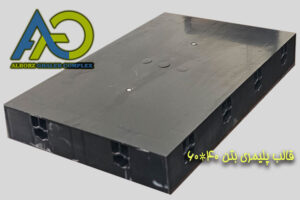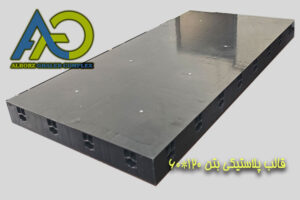
Plastic concrete formwork — also called polymer formwork — is a modern tool for shaping fresh concrete. The panels are injection-moulded from tough polymers (ABS, PP or PE) and hold the concrete until it gains strength, forming walls, columns, slabs and foundations.
Modular plastic formwork keeps winning ground thanks to standard design, fast connections (lever or pin & wedge) and very low weight: just 10–16 kg per square metre against ~40 kg for steel. Concrete does not stick to polymer, so no release oil is needed. Alborz Ghaleb produces the full range with competitive factory prices — from simple residential jobs to bridges and mass housing.
Standard Sizes & Modular Plastic Formwork Price List
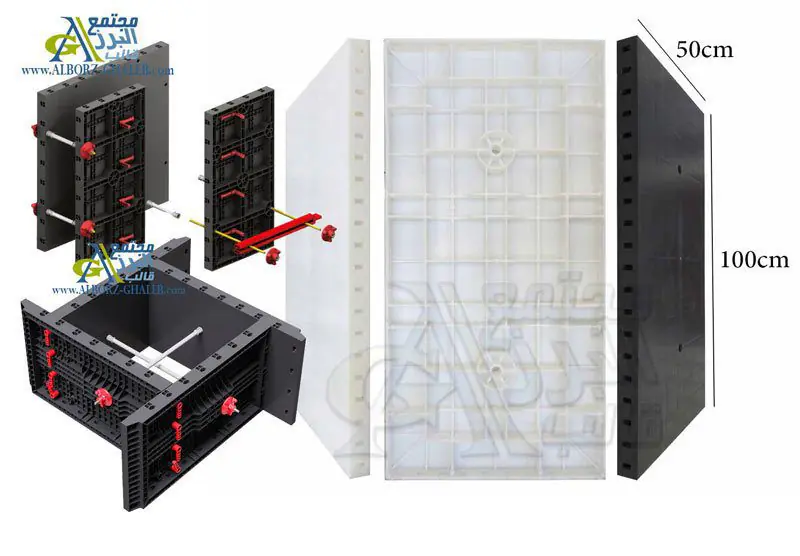
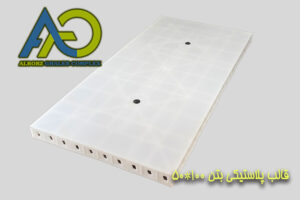
Edge-5 modular panels come in 100×50 down to 100×10 cm (5 cm steps) plus inside/outside corners; lever-type edge-8 panels run 60×120 down to 60×20 cm; special sizes (150×50, 100×60, 80×40/50/60, 90×45) are also produced. Colours: white (virgin material) or black (recycled).
Plastic formwork prices follow the polymer raw-material market and depend on material grade and connection type. Contact us for today's quote:
| Panel type | Available sizes | Daily price |
|---|---|---|
| White modular (virgin) | 100×50 … 100×10 + inside corner | Instant quote |
| Black modular (recycled) | 100×50 … 100×10 + inside corner | Instant quote |
| Black — special sizes | 150×50, 100×60, 80×40/50/60, 90×45 | Instant quote |
What Is Plastic Formwork and Where Is It Used?
Plastic formwork lets contractors execute concrete structures with high precision, more speed and lower cost. On a villa wall in a humid coastal region it delivered a smooth, oil-free finish; on a small bridge project its light weight cut transport costs dramatically. That is why it keeps replacing steel formwork and plywood in more and more projects.
Applications
- Walls: from boundary walls to shear walls — smooth face, fast erection. 🔹 On a Tehran shear-wall job, edge-5 modular panels doubled the installation speed;
- Slabs: flat-slab casting or plywood replacement in joist slabs — light and moisture-proof; outstanding durability in rainy regions;
- Columns: adjustable sections from 20×20 to 60×60 cm with butterfly design. 🔹 Decorative columns on a luxury villa came out with a perfectly smooth face;
- Foundations: strip or raft — recycled black panels make it a true budget option;
- Special structures: bridges, manholes, pools and stairs with custom forming. 🔹 In a pool project, ABS panels handled both concrete pressure and constant moisture.
Why it matters
The form defines both the final shape and the structural quality. A poor-quality form leaks grout and weakens the member — fatal in a shear wall. Polymer panels add light weight, moisture resistance and fast lever/pin connections: on a commercial building, a 60×120 polymer panel weighed just 11 kg and moved between floors by hand, while the equivalent steel panel at ~40 kg needed a crane.
Polymer Materials Compared: HDPE, PP, ABS and Recycled
1) High-density polyethylene (HDPE)
- Profile: good durability, −20…+80 °C service range, light and flexible;
- Pros: the cheapest virgin option, fine for varied climates, easy handling;
- Cons: medium strength, may flex under high pressure — not for heavy jobs;
- Use: simple foundations, low-pressure walls, budget landscaping work.
2) Polypropylene (PP)
- Profile: heat-resistant to +100 °C, withstands corrosion, water, chemicals, impact and abrasion;
- Pros: tougher than PE, better pressure capacity, smoother face;
- Cons: pricier than PE — still cheaper than steel;
- Use: shear walls, medium columns, flat slabs, ordinary residential pressure.
3) ABS
- Profile: high impact and heat resistance (+80 °C), oil/abrasion-proof, dense non-porous smooth face, pressure capacity up to ~80 kN/m²;
- Pros: excellent strength, ideal for exposed concrete and demanding jobs, survives harsh sites — held a 6 m pour without trouble on a Tehran tower;
- Cons: the most expensive material — worth every cent on facade work;
- Use: architectural columns, exposed walls, commercial towers and premium villas.
4) Recycled (usually PE or PP — black)
- Profile: recycled polymers, −10…+60 °C, more brittle;
- Pros: the lowest price, perfect for temporary low-cost work, recyclable;
- Cons: brittle in cold and under pressure, lower surface grade — not for exposed concrete;
- Use: temporary jobs, light foundations, non-visible walls (warehouses).
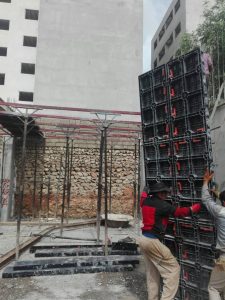
Plastic Formwork Families Made by Alborz Ghaleb
1) Edge-5 modular (pin type)
Sizes 100×50 to 100×15 cm, weight 1.8–5.2 kg; connects with pins & wedges and is fully compatible with modular steel panels; white (virgin) or black (recycled). Use: shear walls, flat slabs, combined foundations, housing.
2) Edge-8 modular (lever type)
Sizes 60×120 to 60×20 cm; weight 2.1–11 kg (ABS) or 1.8–9.1 kg (PP); red PA66 lever locks — no hammer, fast and silent; smooth face for exposed concrete. Use: tall walls, medium columns, large commercial/residential jobs — doubled installation speed on a Tehran commercial building.
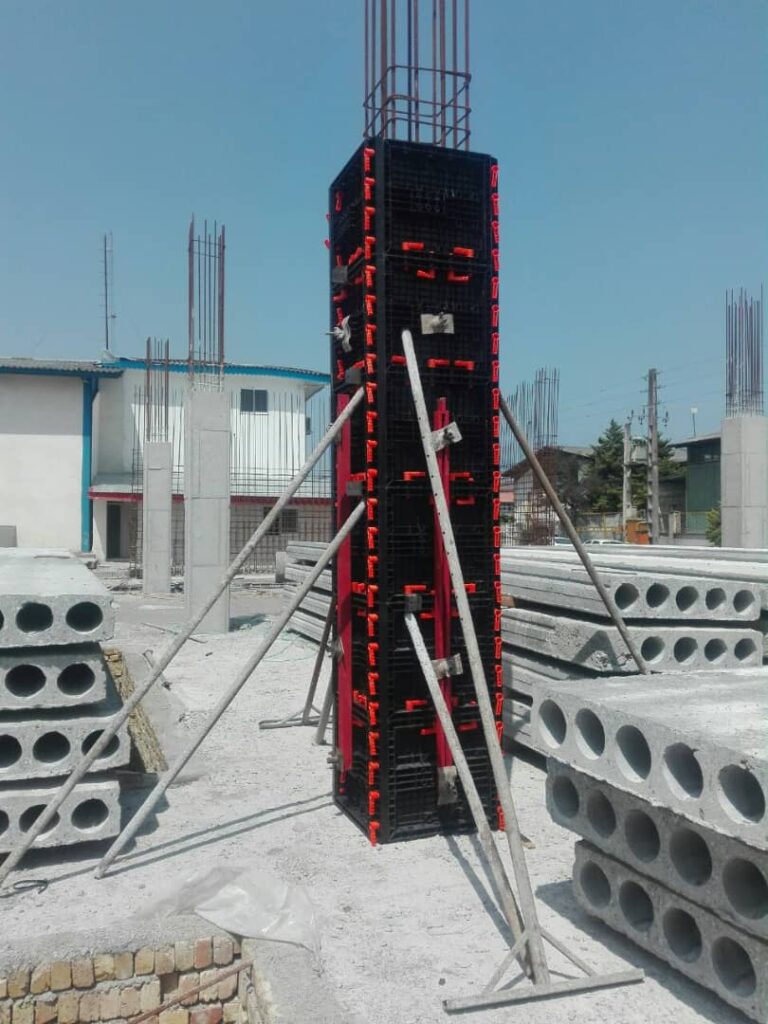
3) Butterfly column formwork
Adjustable from 20×20 to 60×60 cm, total set ~80 kg, butterfly design with multiple bolt holes, quick strip. Use: square, rectangular and L-shaped columns.
Production in five steps
- Design for the target pressure; material selection (PE/PP/ABS/recycled); polymer injection in engineered moulds — high dimensional accuracy, no cutting or welding; quality control (strength, flexibility, pressure tests); packing & direct factory delivery.
Pros, Cons and the Full Steel Comparison
Advantages
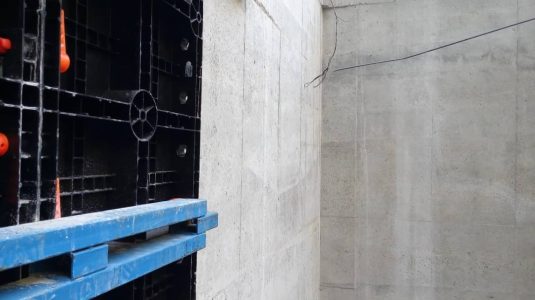
- Light weight: 10–16 kg/m² vs ~40 kg for steel — upper floors without a crane, one worker carries several panels;
- No release oil: concrete does not stick to polymer — fast stripping, clean face;
- Corrosion-free: immune to moisture and chemicals — no rust in humid regions;
- Fast erection: lever/pin connections beat steel — ×2 speed on real jobs;
- Eco-friendly: recyclable — we buy back broken pieces at 50% of price;
- Design flexibility: special columns and curved walls.
Honest disadvantages
- Lower pressure capacity: ABS ~80 kN/m², steel takes more — compensate with extra bracing;
- Not repairable: broken polymer cannot be welded — but we replace at 50% of the price;
- Heat sensitivity: above 80 °C deformation is possible — mind summer storage;
- Shorter life than steel: 60–100 uses vs up to 150.
Plastic vs steel at a glance
| Feature | Plastic formwork | Steel formwork |
|---|---|---|
| Weight per m² | 10–16 kg | ~40 kg |
| Service life | 60–100 uses | up to 150 uses |
| Release oil | not needed | before every pour |
| Rust | none | needs paint in humidity |
| Repair | replacement (50% buy-back) | easy welding |
| Pressure capacity | up to ~80 kN/m² | higher — mass pours |
| Best for | housing, floors, humid regions | heavy, high-repetition projects |
For heavy projects see modular steel formwork — many contractors combine both: steel foundations + polymer walls and slabs. New polymer panels also beat used steel: no waves, no oiling, exposed-grade face — often at a lower price than second-hand steel from the used marketplace.
What Drives the Plastic Formwork Price?
- Material: ABS premium; PE and recycled budget;
- Size: 60×120 costs more than 100×15;
- Connection: lever type (edge-8) above pin type (edge-5);
- Colour/grade: virgin white stronger and pricier; recycled black economical;
- Raw-material market: polymer price swings feed directly into the final price.
Made by Alborz Ghaleb — Export to the Region
Our Karaj (Kamalshahr) plant produces modular plastic formwork, lever-type polymer panels and plastic waffle/void-former systems on advanced injection machines with experienced engineers. Factory visits by appointment — inspect material grade and pressure tests yourself. We ship across Iran and export to Iraq, Turkey, Armenia, Russia and CIS countries with official invoices. Pair the panels with formwork accessories and prop jacks from the same source.
Buy Plastic Formwork Factory-Direct — How It Works
Alborz Ghaleb sells plastic concrete formwork with no middlemen, straight off the Karaj production line — so your landed cost sits several steps below market and every panel is freshly moulded. Buying polymer formwork from the factory gives you:
- Factory pricing: no intermediaries = a real, competitive plastic formwork price;
- Free engineering consultation: send your drawing or dimensions before buying — we recommend the right material (ABS/PP/PE/recycled) and the exact panel count, so you never over- or under-order;
- Official proforma & invoice: for companies, contractors and public projects;
- Factory visit & testing: inspect the line and watch pressure tests yourself, by appointment;
- 50% buy-back: we repurchase broken polymer pieces at 50% of the day price — your real depreciation cost is halved;
- Nationwide shipping & export: delivery across Iran and export to the region with official documents.
Quick buying checklist
- ✔️ Define the application: wall, slab, column or foundation;
- ✔️ Estimate concrete pressure: ABS for tall walls and exposed faces, PP for ordinary work, recycled for temporary jobs;
- ✔️ Pick the connection system: already own steel panels? Choose pin-type edge-5 to combine them; want maximum speed? Lever-type edge-8;
- ✔️ Request today's quote: polymer prices move daily with the raw-material market — always confirm before ordering.
Plastic Formwork — FAQ
How much does plastic formwork cost?
Plastic or steel formwork — which should I buy?
Does plastic formwork need release oil?
What is the service life?
Is a heavier plastic panel a stronger panel?
Can plastic panels combine with steel formwork?
Why is polymer better than plywood for slabs?
Do you export plastic formwork?
White vs black panels — what's the price difference?
How do I start a purchase?
Get Today's Plastic Formwork Price
Send your project dimensions or drawing — our engineers recommend the right material (ABS/PP/PE/recycled) and return an official proforma. 50% buy-back on broken pieces, shipping across Iran and export to the region.
COLUMN PLASTIC FORMWORK
for square and rectangular concrete columns – is an adjustable, lightweight, modular plastic formwork system ideal for unique form configurations.
The Star plastic column formwork system for concrete structures is a universal solution for the forming of columns, pile caps, footings, plinths, and more.
Star panels are connected using the nylon handle with a simple 90 degree twist. Tie rods and anchor nuts are used to prevent bulging on larger width columns.
Form columns from 200 – 1000 mm wide in 105 different size combinations
Because the Star column formwork system is made from high-strength, lightweight ABS at less than 10 kg per piece, crane time can be drastically reduced.
Smart formworkers are experiencing a significant saving of time and resource costs to their jobs.
Your opinion matters to us
Share your experience and thoughts with us and other users
No comments yet. Be the first!