
Introduction: The End of the “Scaffolding Era”
For decades, the skyline of developing cities has been obscured by ugly, rusty webs of tubular scaffolding. While traditional scaffolding has served its purpose in the construction industry, let’s face the harsh reality: it is slow to erect, exorbitantly expensive to rent for high-rise projects, poses significant security risks (inviting theft), and unfortunately, contributes to a high number of workplace accidents.
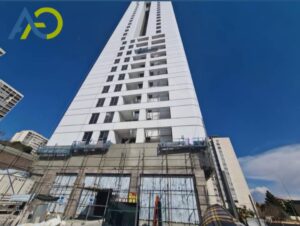
Is it not time to embrace modern engineering? Enter the Suspended Platform, widely known in the local market as the “Climber” or internationally as the “Swing Stage”. This equipment is not merely a machine; it represents a paradigm shift in construction logistics. Whether you are applying cement render to a 20-story residential tower, installing glass curtain walls on a commercial hub, or performing routine maintenance, the electric suspended platform offers a solution that is safer, exponentially faster, and significantly more cost-effective than static scaffolding.
At Alborz Ghaleb, as a pioneer in supplying advanced construction formwork and machinery, we believe that “safe access to heights” is a fundamental right for every worker and engineer. In this comprehensive guide, we will dismantle the technical complexities of these machines—from the “Parachute” safety mechanism that guarantees life safety to a detailed ROI (Return on Investment) analysis. If you are still signing checks for expensive scaffolding rentals, pause and read this first.
Unlike Metal Modular Formwork, which shapes the structure from the inside during the concrete pouring phase, the Suspended Platform is designed to provide access to the skin or façade of the building for finishing works.



What is a Mast Climber? An Engineering Breakdown
While it may look like a simple “construction elevator,” a mast climber is a sophisticated piece of engineered equipment with a precise technical definition and a complex interplay of mechanical and safety systems. Understanding its components is the first step to appreciating its capabilities and respecting its operational requirements.
The Official Definition: Mast Climbing Work Platform (MCWP)
Technically defined, a Mast Climbing Work Platform (MCWP) is a temporarily installed, motorized access platform that is affixed to one or more vertical masts. It is designed to transport personnel and their tools and materials to an elevated working position along the facade of a structure. Unlike a transport platform or construction hoist, the MCWP’s primary function is to serve as a working platform, not just a means of vertical transport.
Anatomy of a Mast Climber: The Core Components
A standard MCWP system is an assembly of precision-engineered parts. Each component is critical to the platform’s stability, mobility, and, most importantly, its safety.
The Platform (Single vs. Twin Mast Configurations):
This is the work area, a robust cage constructed from high-strength steel or aluminum. It features a non-slip floor, standard guardrails, and toeboards to prevent tools and materials from falling. Platforms are modular and can be configured in various lengths (from 2m to over 30m) and shapes.
- Single Mast: Uses one mast, typically positioned in the center or at one end of the platform. Ideal for lighter loads and smaller work areas.
- Twin Mast: Uses two masts, one at each end of the platform. This configuration provides significantly higher load capacities and allows for much longer platforms, making it ideal for large-scale facade work.
The Mast Sections (Rack and Pinion System):
The mast is the backbone of the system. It is assembled on-site from multiple, stackable steel sections (typically 1.5 meters tall). One side of the mast features a toothed “rack.” The drive unit’s “pinion” gear engages with this rack to climb or descend, providing a positive, non-slip drive system that is far safer and more reliable than wire rope hoists for this application.
The Drive Unit (Motor, Gearbox, and Brakes):
This is the powerhouse of the mast climber. Mounted on the platform, the drive unit houses the electric motor (single or three-phase), a heavy-duty gearbox that provides the necessary torque, and the primary service brake system. This unit powers the pinion gear that drives the platform up and down the mast.
The Overspeed Safety Device (Parachute Brake):
This is the most critical safety component on the machine. The overspeed safety device (often called a parachute brake or block-stop) is a completely independent, mechanical braking system. It constantly monitors the platform’s speed of descent. If this speed exceeds a preset limit (indicating a motor/gearbox failure or a “free-fall” situation), it instantly and automatically deploys a set of powerful jaws that clamp onto the mast, bringing the platform to an abrupt and safe halt. This system is the ultimate life-saving guarantee.
The Base, Anchors, and Tie-ins:
The entire structure rests on a robust steel base at ground level. As the mast is erected, it must be anchored to the building structure at regular intervals (e.g., every 6-9 meters) using tie-ins. These anchors prevent the mast from buckling under load and ensure its vertical stability, especially in high winds.
The Control Panel:
Located on the platform, this is the operator’s command center. It includes the “up” and “down” controls, a keyed power switch, and the master Emergency Stop button, which immediately cuts all power to the machine.
The Working Principle (How it Works)
The system is ingenious in its simplicity and does not typically require drilling or damaging the building’s façade. It operates on three main components:
- The Suspension Mechanism: Located on the roof, this is a beam system weighed down by heavy counterweights (usually concrete or cast iron blocks). It acts as the anchor point.
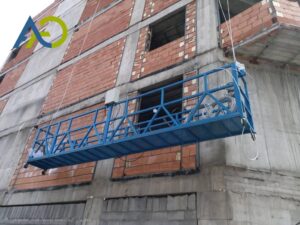
- The Hoist Motors: Two electric traction hoists are mounted on the platform itself. These motors “climb” up the wire ropes using a friction-traction mechanism, lifting the basket and the workers to any desired height.
- The Modular Basket: The platform is not a single rigid piece. It is modular (like LEGO), usually coming in 2-meter sections. This allows site managers to adjust the length of the platform from 2 meters up to 6 or even 8 meters, depending on the width of the building’s façade.
This machinery falls under the category of essential Construction Machinery, streamlining operations just as a tower crane does for lifting heavy materials.
The Ultimate Showdown: Mast Climber vs. Traditional Scaffolding
Choosing between a mast climber and scaffolding is one of the most impactful decisions a project manager can make, directly influencing the project’s timeline, budget, and safety record. While scaffolding is familiar, a data-driven comparison reveals the overwhelming advantages of the MCWP in most modern construction scenarios.
The ROI Analysis: A Real-World Cost-Benefit Breakdown
Let’s move beyond vague claims and analyze a typical project: Applying the facade to a 15-story building with a 30-meter wide elevation over a 4-month project timeline.
| Metric / Parameter | Scenario 1: Using Mast Climbers (e.g., 2 Twin-Mast MCWPs) | Scenario 2: Using Traditional Scaffolding |
|---|---|---|
| Equipment Rental & Install Cost | Moderate. Includes monthly rental for 2 MCWPs + initial installation fee. | Extremely High. Includes monthly rental for ~4,500 m² of scaffolding + a very high initial erection fee by a specialized crew. |
| Installation / Erection Time | 1-2 days. A small, specialized crew can fully install and commission two MCWPs. | 2-3 weeks. A large crew is required to erect the entire scaffolding structure from the ground up. |
| Dismantling Time | 1 day. | 1-2 weeks. |
| Labor Productivity | Very High. Workers are always at the optimal ergonomic height. Materials are loaded directly onto the platform, eliminating manual handling between floors. | Low. Significant time is wasted climbing stairs/ladders and manually transporting materials to different levels of the scaffold. |
| Project Timeline Impact | Accelerates timeline. The 3 weeks saved on erection/dismantling can be used for productive work. Daily tasks are completed faster. | Extends timeline. The project cannot start until the scaffolding is fully erected. |
| Site Congestion & Logistics | Minimal. Only a small footprint at the base. Truck access to the building facade remains clear. | Severe. The entire facade is blocked. Staging and storing scaffolding components create major logistical issues. |
| Final Verdict | Lower Total Project Cost. Despite a monthly rental fee, the massive savings in labor, project time, and scaffolding erection costs result in a significantly more profitable project. | Higher Total Project Cost. The enormous cost of scaffolding rental and the extended project timeline make this a far more expensive option. |
Economic Conclusion: The mast climber is a productivity multiplier. The initial investment or rental cost is rapidly offset by dramatic reductions in labor expenses and accelerated project completion, leading to higher profitability and earlier project handover.
The Safety Verdict: A Data-Driven Look at Why MCWPs Reduce Accidents
- Fall Protection is Inherent: Workers operate within a fully guard-railed platform. This eliminates the risk of falling from an open edge or through a gap between scaffold planks, which is one of the leading causes of fatalities in construction.
- Reduced Material Handling Injuries: Scaffolding requires workers to manually carry heavy loads up stairs and along narrow platforms, leading to strains, sprains, and back injuries. With an MCWP, materials are loaded at ground level and lifted effortlessly to the work-face.
- Superior Stability & Engineering: MCWPs are engineered systems subject to rigorous testing and standards (like EN 1495). They are anchored directly to the building, making them far more stable than a complex scaffold structure, which is susceptible to improper assembly and component failure. The presence of the overspeed safety device provides a level of redundant safety that scaffolding simply cannot offer.
The Productivity Boost: How Mast Climbers Accelerate Project Timelines
- Instant Vertical Access: Instead of a 10-minute climb, workers can travel 15 stories in under 2 minutes. This “Time to Work-Face” is dramatically reduced, translating into more productive hours each day.
- Optimal Ergonomics = Faster Work: Workers are not bending, stretching, or working in awkward positions. By keeping the work surface at the perfect height, they work faster, with higher quality, and less fatigue.
- Unobstructed Facade: Because the MCWP only touches the building at its anchor points, it allows for the installation of large panels, windows, or EIFS sections without the interference of scaffold tubes. This is a level of advanced height access and support system that allows for the streamlined installation of complex facade elements, just as specialized formwork like waffle formwork enables complex concrete structures.
Why Choose a Suspended Platform Over Traditional Scaffolding?
The decision between using a Climber or erecting a massive scaffolding structure is purely mathematical. For any project manager focused on efficiency, the Suspended Platform wins on almost every front. Here is the comparative breakdown:
A) Cost Efficiency (The ROI Factor)
Scaffolding costs are volume-based; you pay for the steel to cover the entire face of the building, from the ground up to the 20th floor, even if you are only working on the top floor.
- The Climber Advantage: With a Suspended Platform, you pay for the machine, not the height. Whether you are working on the 5th floor or the 50th floor, the cost remains virtually the same (only the wire rope length changes). For mid-to-high-rise buildings, this results in 30% to 50% savings compared to scaffolding rental.
B) Speed of Setup and Mobility
Erecting scaffolding for a 10-story building can take a skilled team over a week. Dismantling it takes almost as long.
- The Climber Advantage: A Suspended Platform can be assembled and installed by a small crew in 1 to 2 days. Furthermore, once the work on one side of the building is done, the suspension mechanism (on wheels) can be easily rolled to the next side, drastically reducing downtime.
C) Site Security and Aesthetics
Scaffolding essentially creates a ladder for thieves to access apartments on any floor. It also blocks sunlight and views, frustrating residents in renovation projects.
- The Climber Advantage: At the end of the shift, the platform is raised to the roof or lowered to the ground and locked. There is no permanent structure for unauthorized access. The building’s façade remains visible and clean during construction.
D) Heavy Load vs. Light Access
It is important to note where scaffolding still wins. If your project involves heavy structural support (e.g., supporting a heavy concrete slab during pouring), you cannot use a Climber. In such cases, load-bearing Modular Scaffolding Systems (like Cuplock or Ringlock) are mandatory. However, for painting, plastering, cleaning, and light installation, the Climber is the superior choice.
A Guide to Mast Climber Types & Their Specific Applications
Not all mast climbers are created equal. The right choice depends on your project’s height, the nature of the work, the required load capacity, and even your site’s power availability. Making a smart selection is key to maximizing efficiency.
1. Electric Mast Climbers (Single-Phase and Three-Phase): The Professional’s Choice for High-Rises
This is the most common and efficient type for medium to large-scale construction projects. Powered by electric motors, they offer superior speed and lifting power.
- Three-Phase MCWPs: This is the workhorse of the facade industry. Utilizing industrial three-phase power, it delivers exceptional lifting capacity and speed, making it the best choice for high-rise towers, heavy-duty applications (like masonry or stone cladding), and continuous, long-term use.
- Single-Phase MCWPs: An excellent option for projects without access to three-phase power or for low-to-mid-rise buildings. They are simpler to set up electrically but generally offer lower speeds and load capacities compared to their three-phase counterparts.
2. Manual Mast Climbers: The Economical Solution for Low-Rise and Light-Duty Work
With a manual mast climber, the vertical movement of the platform is generated by human power, using a hand-cranked winch system.
- Primary Application: This system is suitable for low-rise buildings (typically up to 4-5 stories), very light-duty tasks (like facade inspections, painting, or sealant application), and sites with absolutely no access to electrical power.
- Pros & Cons: The main advantage is a much lower purchase or rental price and independence from a power source. However, the significant drawback is the very slow operational speed and the physical exertion required, which reduces operator efficiency and is impractical for larger projects.
3. Monorail Systems: The Smart Solution for Curved and Complex Facades
Modern architecture is filled with curves, setbacks, and complex geometries. Standard mast climbers, which only travel vertically, cannot service these structures effectively. The monorail system is the engineering answer to this challenge. A steel track (monorail) is installed on the roof, precisely following the building’s contours. The mast climber is suspended from a trolley that travels along this rail, giving it both vertical and horizontal movement capabilities.
- Primary Application: Facade maintenance and work on buildings with unique architectural designs, circular towers, and any structure where simple vertical access is insufficient. This system is a testament to how modern equipment solves complex architectural challenges, much in the same way that advanced formwork systems like waffle slab formwork make it possible to create vast, open-plan interior spaces.
4. Specialized Mast Climbers (e.g., for corners, ledges)
For highly specific needs, custom models are available. For instance, some mast climbers are designed with extensions to reach under ledges or balconies, while others are shaped to fit perfectly into the corners of a building, ensuring 100% facade coverage.
Critical Safety Features: How We Guarantee Your Life
The number one concern for any worker stepping onto a suspended platform is: “What happens if the wire rope breaks?”
Modern engineering has solved this. Our ZLP series platforms are equipped with a “Triple Protection” system that makes free-fall virtually impossible.
1. The Safety Lock (Parachute System)
This is the most critical component. It is a purely mechanical device, independent of the electrical system.
- How it works: If the platform tilts more than 4 degrees or if the primary working rope snaps causing a sudden increase in descent speed, the Safety Lock’s internal steel jaws instantly clamp onto the Secondary Safety Rope.
- Result: The platform freezes in place within centimeters. This mechanism is as reliable as the load-bearing calculations used in One-way Waffle Slab engineering—designed to hold loads far exceeding the actual weight.
2. Centrifugal Speed Limiter
Located inside the hoist motor, this device prevents the platform from descending faster than the rated speed (manual descent speed limit). It ensures a controlled descent even when using the manual release lever during a power outage.
3. Electrical Safety Sensors
- Upper Limit Switch: Prevents the basket from crashing into the roof suspension mechanism.
- Overload Sensor: (Optional on some models) Stops the motor if the weight exceeds the rated capacity.
Just as Adjustable Ceiling Jacks (Prop Jacks) provide critical support during slab construction, these safety features provide the necessary redundancy to ensure worker confidence and safety at extreme heights.
ایمنی و استاندارد (Safety Authority)
آیا کلایمر سقوط میکند؟ بررسی سیستمهای ایمنی
خیر، اگر استاندارد باشد.
معرفی اجزا:
- ترمز پاراشوت (Parachute/Block Stop).
- سیستم ترمز گریز از مرکز.
- سیم بکسلهای یدکی (Safety Wire).
اجزای تشکیل دهنده پکیج کلایمر
وقتی شما یک دستگاه کلایمر از “البرز قالب” سفارش میدهید، چه قطعاتی تحویل میگیرید؟
- پلتفرم یا سبد (Platform): معمولاً از قطعات ۲ متری و ۱ متری تشکیل شده که با پیچ و مهره به هم وصل میشوند. کف سبد از ورق آجدار آلومینیومی یا گالوانیزه است تا کارگر لیز نخورد.
- سازه نگهدارنده بام (Suspension Mechanism): شامل بازوهای کشویی است که قابلیت تنظیم ارتفاع و طول پیشروی (Overhang) را دارند.
- وزنههای تعادل (Counter Weights): بلوکهای بتنی یا چدنی (معمولاً ۲۵ کیلوگرمی) که در انتهای بازوها چیده میشوند.
- تابلو برق فرمان: مغز متفکر دستگاه که فرمان حرکت، ترمز و کنترل فاز را صادر میکند.
- وینچهای کشنده: شامل الکتروموتور، گیربکس و درام سیم جمعکن.
نکته فنی: در شرایط خاصی که بام ساختمان شیبدار است یا فضای کافی برای چیدن وزنه تعادل وجود ندارد، میتوان از جک سقفی، جک صلیبی برای مهار کردن بازوها به سقف سازه استفاده کرد (تکیهگاه اصطکاکی). البته این روش نیاز به تایید کارشناس فنی دارد.
The Non-Negotiable Safety Bible: Your Mast Climber Safety Checklist
Safety is not an option when working with mast climbers; it is an absolute requirement. A properly maintained and operated MCWP is statistically far safer than scaffolding. However, this safety is contingent upon strict adherence to protocols and continuous inspection. Treat this checklist as law on your job site.
Part 1: Pre-Installation Site Assessment
Safety begins on the roof, not in the basket.
- Roof Structural Integrity: Ensure the roof structure can support the full load of the MCWP, its occupants, and the heavy ballast weights, especially on older buildings.
- Correct Ballast Calculation: The number of counterweights must be calculated precisely according to the manufacturer’s specifications based on the outrigger beam’s overhang length. Insufficient ballast risks catastrophic tipping.
- Secure Foundation: The base of the mast and the outrigger supports must be placed on solid, level ground or structurally sound points on the roof (e.g., over primary beams), not on weak points like insulation or waterproofing membranes.
- Establish a Danger Zone: Cordon off the area directly beneath the mast climber’s work zone with danger tape to prevent unauthorized personnel from entering.
Part 2: The Operator’s Daily Pre-Use Inspection (Printable Checklist)
This check takes less than 5 minutes but is the most critical life-saving routine. It must be performed by a trained operator before every shift.
- ✅ Visual Wire Rope Check: Inspect all wire ropes for any signs of damage: broken strands, kinks, crushing, or corrosion. Do not operate the machine if any defect is found.
- ✅ Test Service Brakes: Raise and lower the platform slightly. Does it stop smoothly and hold its position without slipping?
- ✅ Test Overspeed Safety Device (Parachute Brake): Following the manufacturer’s procedure, perform a drop test to ensure the parachute brake engages correctly. This is the most important daily test.
- ✅ Test Emergency Stop Button: Press the large red E-stop button. Does all power cut out and the machine stop immediately?
- ✅ Check Electrical Connections: Ensure the power cable is free of cuts or abrasions and all connections are secure.
- ✅ Platform Housekeeping: Clean any oil, grease, or debris from the platform floor to prevent slips.
Part 3: Periodic Inspections and Preventive Maintenance
- Weekly: Check the tightness of all structural bolts and nuts on the platform, mast sections, and outriggers.
- Monthly: Check the gearbox oil level. Inspect the motor’s service brake pads for wear.
- Annually (or per manufacturer/local regulations): A full load test and inspection by a certified third-party inspection company is mandatory to recertify the machine for use.
Part 4: Critical “Don’ts”—Prohibited and Deadly Practices
- ❌ Overloading: Never exceed the maximum load capacity specified on the machine’s data plate.
- ❌ Operating in Bad Weather: Operating a mast climber in high winds (typically above 25-30 mph or 12 m/s), thunderstorms, or heavy rain is strictly prohibited.
- ❌ Bypassing Safety Systems: Never tamper with, disable, or bypass the parachute brake, limit switches, or overload sensors.
- ❌ Using as a Material Hoist: The MCWP is for personnel and their tools, not for lifting bulk loads of materials like a dedicated hoist.
- ❌ Welding on the Platform: Avoid welding from the platform or attaching a welding ground to it unless specific safety procedures are followed, as the current can damage wire ropes and electronic components.
A professional contractor understands that job site safety is a holistic system. It relies on the integrity of all equipment, from the primary access platform to the support systems on the ground. A deep understanding of how to safely use heavy-duty shoring jacks or properly erect modular scaffolding systems for ground-level access is just as crucial as operating the mast climber itself.
The Heart of the Machine: A Deep Dive into Drive & Safety Systems
Understanding the technology that powers a mast climber helps you appreciate the engineering that keeps you safe and productive at height.
The Advantage of Rack and Pinion Drive Systems
Unlike some suspended platforms that use wire rope hoists, most modern MCWPs use a rack and pinion drive system. A pinion gear, powered by the motor, engages with the “rack” (a toothed rail on the mast). This provides a positive, mechanical engagement that is not prone to the slipping or stretching that can affect wire rope systems. It ensures a smooth, stable ride and precise positioning. This commitment to robust and direct mechanics is a principle we also apply to our heavy-duty steel formwork panels, where strength and reliability are paramount.
The Mechanical Genius of the Overspeed Safety Device
The parachute brake is a masterpiece of mechanical safety engineering. It operates on a centrifugal force principle. Inside the device, a set of weighted arms or a pendulum is calibrated to a specific rotational speed. During normal descent, these arms remain in place. However, if the platform’s descent speed exceeds the safe limit, the increased centrifugal force throws these arms outward, tripping a powerful spring-loaded mechanism. This instantly slams a set of high-friction brake jaws or a toothed cam onto the mast, bringing the platform to a complete and secure stop in a matter of centimeters. It’s a purely mechanical system that requires no electricity to function, making it a truly foolproof life-saver.
The Critical Role of High-Grade Steel and Anchoring
The strength of the entire system depends on the quality of its steel. The masts, platform, and especially the tie-in anchors are manufactured from high-tensile steel and subject to rigorous quality control and welding standards. The tie-ins, which anchor the mast to the building, are the critical link that transfers wind loads and ensures the mast remains perfectly vertical and stable. Proper installation and torquing of these anchors are as important as the strength of the steel itself.
A Contractor’s Guide to Buying & Renting Mast Climbers
Once you’ve decided an MCWP is right for your project, the next step is acquisition. Should you rent or buy?
Rent vs. Buy: A Strategic Business Decision
- Renting: This is the ideal choice for contractors who work on projects of varying scales or only need a mast climber for a specific, one-off job. Renting eliminates the high initial capital outlay, as well as the costs associated with storage, maintenance, and certification. It provides flexibility and access to the latest models.
- Buying: For large construction companies, facade specialists with a continuous pipeline of high-rise projects, or building management firms, buying a mast climber is a long-term strategic investment. The initial cost is recouped over several projects, and the machine becomes a profitable asset for the company.
Key Questions to Ask Before Renting a Mast Climber
- What is included in the rental fee? (e.g., installation, dismantling, operator training, monthly inspection).
- What is your emergency service response time? If the machine breaks down, how quickly will a technician be on-site?
- Are your machines independently certified? Ask to see the latest third-party inspection and load test certificates.
- Do you provide certified operator training?
Inspecting a Used Mast Climber: A Buyer’s Checklist
- Prioritize the Drive Unit: The motor, gearbox, and safety device are the most critical and expensive components. Check the brand, service history, and any signs of oil leaks or excessive wear.
- Inspect the Masts for Damage: Look for any bent or damaged teeth on the rack, and check all welds for cracks.
- Check the Platform’s Structural Integrity: Look for signs of deformation, rust, or damage from overloading.
- Demand Documentation: Ask for the original manufacturer’s manual, all service and maintenance records, and past inspection certificates. Never buy a used mast climber without a complete paper trail.
Factors That Influence Mast Climber Pricing
- Brand and Origin of Drive Unit: European-made drive systems (e.g., from Germany or Sweden) are typically the most expensive and reliable.
- Load Capacity: An 800kg capacity machine will cost more than a 500kg one.
- Mast Type and Height: The total height of the mast required significantly impacts the cost.
- New vs. Used: A used machine can be 30-50% cheaper, but comes with higher risks.
Installation Guide: The Suspension Mechanism (No Drilling Required)
One of the unique advantages of the standard Climber system is the Counterweight Suspension Mechanism. Building owners often worry about damaging the roof waterproofing (Iso-gum). Here is how we avoid that:
The Beam System
The mechanism consists of a front beam (overhanging the wall) and a rear beam. It rests on wheels or flat base plates.
- The Physics: Heavy counterweights (typically 900kg to 1000kg of concrete or cast iron blocks) are placed on the rear beam. The leverage ratio ensures the basket is held safely.
- Roof Protection: We recommend placing wooden planks or rubber pads under the mechanism’s wheels to distribute the load and protect the roof insulation.
Alternative: Parapet Clamps
In some modern buildings with high parapet walls where there is no space for a beam system, we can use Parapet Clamps. These clamp directly onto the structural wall.
- Note: Before using clamps, the structural integrity of the parapet wall must be verified, similar to how one checks the load-bearing capacity for Two-way Waffle Formwork systems.
Applications Beyond Façade Coating
While Climbers are famous for cement rendering and painting, their versatility extends much further in the modern construction industry:
- Curtain Wall Installation: For installing glass panels and Aluminum Composite Panels (ACP), the stable platform allows for precision work that scaffolding cannot match.
- Maintenance & Cleaning (BMU): Permanent Building Maintenance Units are essential for glass towers.
- Simultaneous Construction: Smart project managers can fast-track their projects. While the structure is being built using Waffle Formwork on the top floors, finishing teams can use Climbers on the lower floors to install the façade. This parallel workflow drastically reduces the overall project timeline.
Buying Guide: Factors Affecting the Price
When requesting a quote for a Suspended Platform, the price can vary based on several factors. Knowing these will help you make an informed decision:
- Platform Material: As mentioned, Galvanized steel costs approx. 15-20% more than painted steel but offers superior longevity.
- Motor Brand: High-end motors (with better heat dissipation and lower noise) command a premium.
- Wire Rope Length: The standard is 100 meters (covering approx. 30 stories). If you have a taller project, you will need longer ropes, which adds to the cost.
- After-Sales Service: Access to spare parts (brake discs, electrical components) is vital. Alborz Ghaleb ensures a full inventory of spares.
Also, consider the resale value. High-quality construction equipment, much like durable Plastic Polymer Formwork, retains its value well and can often be sold as second-hand equipment after the project is completed, recovering a significant portion of your initial investment.
Frequently Asked Questions (FAQ)
Is a mast climber safer than scaffolding?
Yes. When properly installed, maintained, and operated by trained personnel, an MCWP is statistically safer than scaffolding due to its solid work platform, integrated guardrails, and automated emergency safety systems.
What is the load capacity of a typical mast climber?
Capacities vary widely, but common models range from 500 kg to 2,000 kg (approx. 1,100 lbs to 4,400 lbs) or more, depending on whether it’s a single or twin-mast configuration.
Do you need a license to operate a mast climber?
Yes. In most jurisdictions (including OSHA and EN regulated areas), operators must be trained and certified as competent by a qualified person. This training covers daily inspections, safe operation, and emergency procedures.
How much does it cost to rent a mast climber?
Rental costs are typically calculated on a monthly basis and depend on the machine’s size, capacity, and the duration of the rental. Long-term rentals are usually cheaper per month. Contact a reputable supplier for a project-specific quote.
Can I use the Climber with single-phase household electricity?
Yes. While heavy-duty models use 3-phase power, most standard ZLP 630 models are compatible with single-phase (220V) power, making them easy to use on any site.
What happens if the power goes out while I'm in the air?
You will not be stuck. The motors are equipped with a Manual Release Lever. By pulling this lever, the platform will descend slowly and safely to the ground using gravity.
Can the platform length be customized?
Yes. The modular design means you can assemble it as a 2m, 4m, or 6m platform depending on the specific width of the drop you are working on.
Alborz Ghaleb: Your Partner in Safe and Efficient Vertical Access
At Alborz Ghaleb, we understand that a construction project’s success is built on a foundation of safe, efficient, and reliable equipment. The mast climber represents the pinnacle of modern access technology, and we are proud to be your expert partner in implementing it.
A Commitment to Global Safety Standards
Safety is not a feature for us; it is the core of our business. We only supply mast climbers and access equipment that meet or exceed the most stringent international safety standards. From the quality of the motor to the integrity of the parachute brake, no detail is overlooked.
Decades of Engineering Expertise in Access & Formwork
Our expertise is not limited to a single product. We are consultants who understand the entire building process. We can help you choose the most effective access solution, whether it’s a mast climber for a skyscraper, a specialized waffle formwork one-way system for a long-span slab, or a two-way waffle slab formwork for a large atrium.
A Consultative Approach: We Solve Problems, Not Just Sell Products
Our technical team is ready to analyze your project’s unique challenges and recommend a holistic solution. We believe in providing value through knowledge. We offer a complete portfolio, from the most advanced construction machinery to innovative, lightweight polymer-based plastic formwork, ensuring you have the right tool for every job.
Conclusion: Elevate Your Standards
The transition from bamboo or tubular scaffolding to Suspended Platforms (Climbers) is a sign of a mature, safety-conscious, and efficient construction company. It saves money, saves time, and most importantly, provides a dignified and safe working environment for your team.
At Alborz Ghaleb, we provide not just the equipment, but the engineering support to install, certify, and maintain it. Whether you are looking to buy or rent, our ZLP series platforms are ready to elevate your project.